Giulia Blocal
In 2013, the Fare Ala collective launched Pizzo Sella Art Village, an unsanctioned street art project on Monte Gallo, just outside Palermo, using its abandoned villas to draw attention to the Mafia-linked building speculation that had transformed this stretch of the Sicilian coastline.

The history of Pizzo Sella Art Village
In 1978 a construction company affiliated with the Sicilian Mafia obtained a series of planning permissions to build villas within a natural reserve near Palermo (Monte Gallo mountain).
Here, the collusion between local government and the Mafia that underpinned the so-called Sacco di Palermo, the wave of building speculation that transformed the city during the 1960s and 1970s by replacing green areas and historic villas with speculative construction, allowed around 170 villas to be built illegally on Monte Gallo, effectively privatizing an entire mountain.

In 1984 these buildings were impounded but, while most of them were left unfinished and eventually abandoned, 50 villas were turned over to their legal owners. They now constitute a guarded residence, thus blocking the access to the mountain to the rest of the population.

Welcome to Pizzo Sella Art Village
In 2013, the art collective Fare Ala created a mock commercial presenting the abandoned villas near Palermo as a luxury holiday destination complete with its own prestigious art gallery. The video went viral and many street artists actually went to Pizzo Sella Art Village to take part in the provocation.

Through these spontaneous, unsanctioned interventions, the artists helped build the mythology around Pizzo Sella Art Village while drawing attention back to Fare Ala’s original concern: the environmental damage represented by the illegal, unfinished villas scattered across the promontory.


Collettivo FX: Redefining Public Art and Community Engagement
Artistic interventions at Pizzo Sella Art Village

Over the following years, street artists continued to add unsanctioned works to Pizzo Sella Art Village. The project developed organically, without a curator or formal programme, as artists arrived independently and used the unfinished villas as surfaces for intervention.


On the unfinished villas scattered across Monte Gallo, I spotted works by Nemo’s, Mangiatori di Patate, Exit/Enter, Hopnn, Ema Jons, Bibbito and Collettivo FX, all unsanctioned interventions that draw attention to the illegal origins of the buildings themselves.


Further stressing the paradox of “vandalizing something that constitutes a vandalization in the first place”, in 2016 several street artists were arrested while painting at Pizzo Sella Art Village. Rather than diminishing interest in the project, the episode drew further attention to the debate around the illegal privatisation of the area.
Gluttony and Street Art in Palermo


TRAVEL AND STREET ART MAPS
MAPS
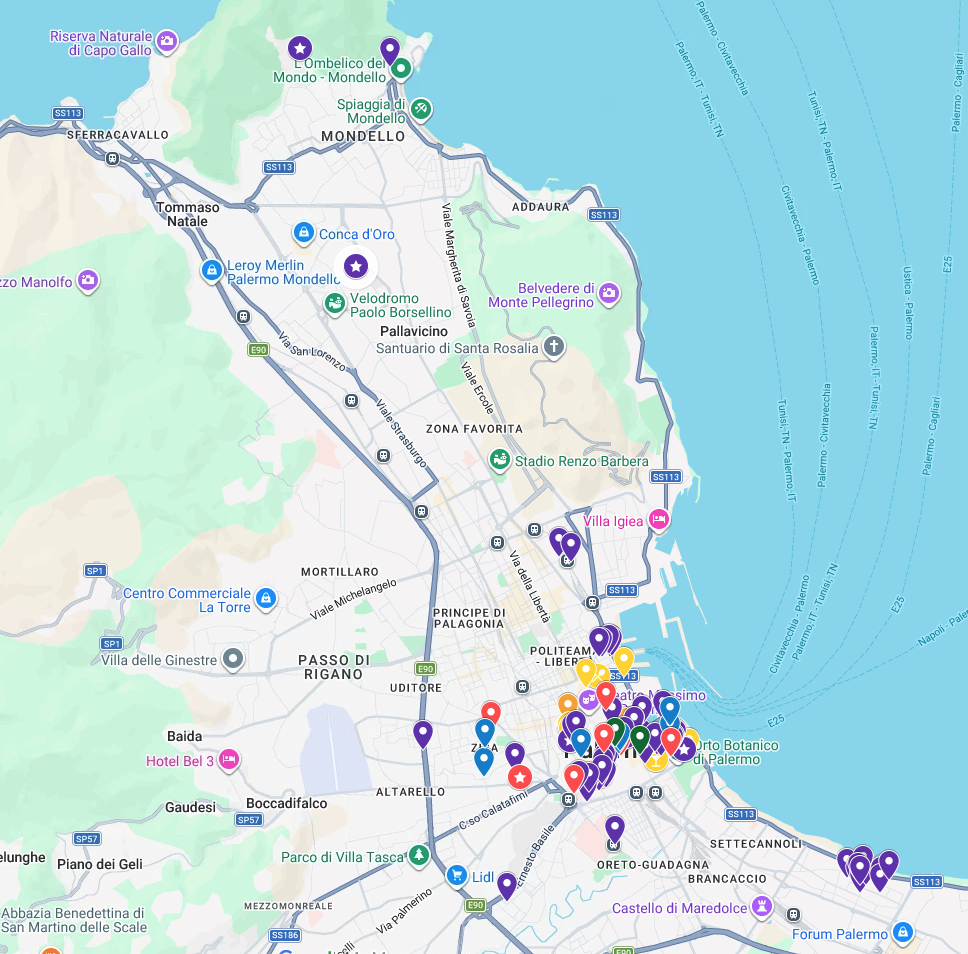
Want the exact locations behind the places mentioned in this article? My travel and street art maps bring together street art spots, neighbourhood notes, restaurants, lesser-known museums and galleries, along with plenty of other off-the-beaten-path suggestions to help you keep exploring beyond the screen.
Pizzo Sella’s symbolic potential also attracted artists and practitioners working beyond street art. In 2018, the site became part of Manifesta 12 through an intervention by the Belgian collective Rotor. The group reopened two paths leading towards the top of Monte Gallo, one historically used by people and another by wild animals, and transformed the concrete skeleton of an unfinished villa into an observation point overlooking the landscape.
The intervention offered another way of experiencing Pizzo Sella while bringing attention back to the illegal construction of the villas and the privatisation of a vast green area of Palermo, using the site to reflect on the relationship between people and the landscape.


What happened to Pizzo Sella Art Village?
The future once imagined for Pizzo Sella Art Village never developed into a formal programme. Fare Ala continued working on projects connected to public space and political memory, but Viva Menilicchi!, developed with Wu Ming 2 for Manifesta 12 in 2018, was the collective’s final operation before it disbanded.
Pizzo Sella itself, however, remains unresolved, suspended between demolition orders and redevelopment proposals. The unfinished villas still mark the landscape above Palermo, carrying the legacy of the building speculation that produced them, while the Art Village has become another layer in the history of the site rather than an ongoing curated project.
What made Pizzo Sella Art Village significant was never simply the accumulation of murals. By intervening without permission on buildings that were themselves the product of illegality, artists exposed a contradiction already embedded in the landscape and brought renewed attention to questions of access, ownership and the long afterlife of Palermo’s building speculation.
🛑 Good to know: like any other abandoned spot in Italy, entering the site is technically illegal. It is also tricky to find a way in, but with enough perseverance, it is possible.