Giulia Blocal
This editorial on Banksy’s anonymity was originally published in my street art newsletter, Beyond the Walls, which lands in inboxes on the 1st of every month with reflections and unexpected finds. This excerpt is from the April 1st, 2026, edition. Subscribe here to receive future issues.
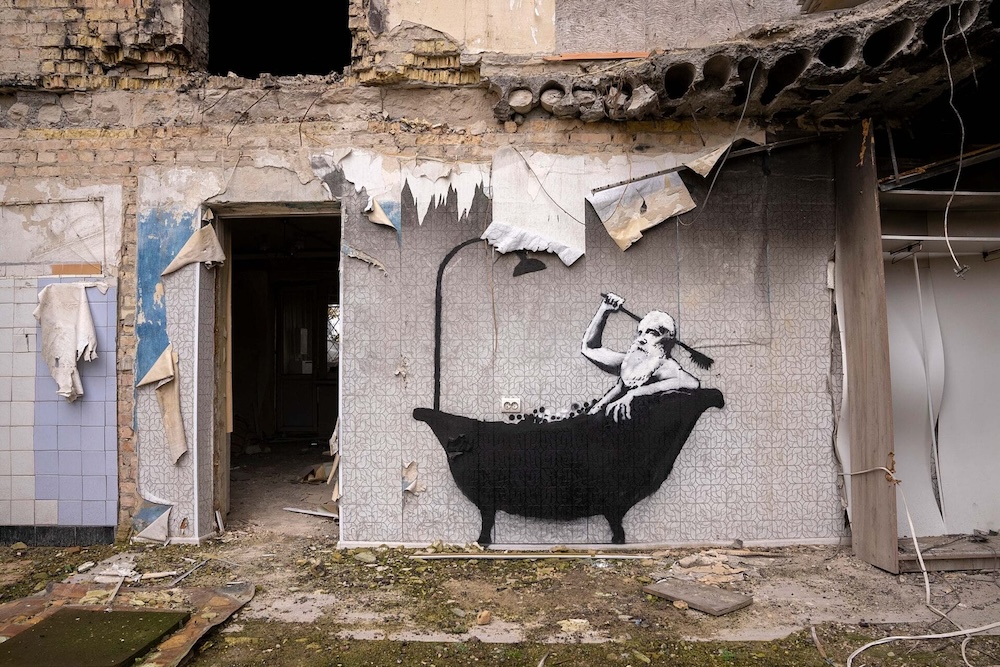
There was never that much to reveal. We already knew who Banksy was, or at least, we knew enough. His name has been circulating for almost twenty years, resurfacing every few years in what has become a media ritual, each time repackaged as a breakthrough.
This was never a mystery to solve, nor a void to fill. It was, much more simply, an individual choice to be respected. Treating it as something to expose for clicks means missing the point of Banksy’s work altogether.
To understand why, you have to step slightly outside the media narrative and look at how anonymity actually functions within street art. In this context, anonymity is not an exception, it is the baseline. In graffiti especially, it is a structural condition of the practice, not a stylistic quirk.
There is a very simple rule that anyone working in this field learns immediately: you do not expose an artist who has chosen to remain anonymous. If you take photos, you ask for consent before showing a face. If you know a name, you keep it to yourself. Breaking that rule is not just bad etiquette, it is considered disrespectful and, more importantly, a form of betrayal.
This matters because it dismantles a common assumption. Banksy’s anonymity is often framed as a calculated branding strategy, a clever way to generate hype around a persona. But within this context, anonymity is neither unusual nor exceptional; it is common practice, and just as commonly, it is respected.
People within the scene knew, and still, there was a tacit agreement to leave that boundary intact, because the mystery itself had become part of the artwork.
Why Banksy’s Anonymity Matters
Banksy’s anonymity removed the noise that usually surrounds an artist, or any public figure: the biography, the personality, the gossip. In a culture increasingly structured around visibility and recognition, where celebrity often becomes the primary lens through which work is consumed, that absence performs a very specific function: it interrupts the logic of celebrity culture and redirects attention to the image and the message.
At the same time, anonymity is not just a conceptual device. It is a condition of freedom. Many of Banksy’s works are political, or at the very least, inconvenient in the contexts in which they appear, and anonymity is what allows those interventions to exist in the first place.
And before anyone argues that Banksy is hardly some radical activist in need of protection, it is worth remembering that in the country where he lives, pro-Palestinian activism has already been met with arrests, prosecutions, and the use of anti-terror legislation. The threshold for becoming “inconvenient” is often much lower than people assume.
Banksy himself put it more simply: “Invisibility is a superpower.”
Why They Unmasked Banksy, For Real
So the question is not “Who is Banksy?” but: Why insist on answering it?
This is not about exposing a criminal, there is no public danger being neutralized, no urgent truth being revealed. What is being satisfied here is something much smaller: curiosity. Or worse, the need to turn anything that already carries attention into content.
You see it in the methods as much as in the outcome. Asking people in a war zone like Ukraine to recognize a face from a series of photos, in order to identify an allegedly anonymous artist, is not just detachment from context. It reveals a complete lack of empathy, a willingness to pursue a story regardless of what surrounds it.
And the consequences follow the same logic. In the days following the unmasking, the image of a Greek construction worker photographed near the Finsbury Park mural began to spread, misidentified as Banksy and amplified through reposts and headlines designed to maximize clicks rather than accuracy. The rule here is: visibility first, verification later.
Once that mechanism is in motion, it does not stop at misinformation. The same image becomes raw material for AI-generated content, fake videos, and low-effort scams, all feeding on the same confusion, all exploiting the same attention. None of this is accidental: this is the ecosystem that forms around a story built for traction.
Banksy is not just an artist, but a generator of attention. Every piece of news associated with his name generates clicks, and therefore value. And that value is exactly what this kind of journalism is designed to capture, not public interest.
Unmasking Banksy: What Gets Lost
In this process of chasing virality, something more subtle gets lost: the balance that made the work powerful in the first place. Banksy’s work has always existed in a tension between presence and absence, between a name that carries weight and an identity that remains just out of reach.
That distance is not accidental. It is what keeps the work from collapsing entirely into the person behind it, what prevents the image from being reduced to biography, gossip, or personality. It leaves room for the work to operate on its own terms, without being immediately absorbed into the narrative of the artist.
Remove that distance, and you do not simply reveal the artist, you change the conditions under which the work is read. The image remains, but its meaning becomes more fixed, more easily contained, more easily consumed.
What gets lost is not the mystery for its own sake, but the space that mystery created, the space in which the work could resist being fully explained, and where the work could still hold a certain kind of magic.