 Giulia Blocal
As Seen on the Streets of… is a series of independent travel books dedicated to the cities that shaped and defined the global street art movement.
Each title is available in two formats: a beautifully crafted coffee-table edition printed on high-quality paper, and a convenient A5 pocket-size version, ideal for taking with you on your adventures.
Rooted in the spirit of “Be Local” (the motto behind my blog BLocal Travel, established in 2011) these books reflect my personal experiences and in-depth research, enriched by the voices of local street artists. They generously shared their favorite neighborhoods, secret corners, places to go, and honest views on the urban art scene in their cities.
Their insights bring an authentic, insider perspective to each book, guiding you beyond the usual tourist trails. From world-famous murals to off-the-radar pieces tucked away in unexpected places, these street art guidebooks offer a deeper, more meaningful way to explore the creative soul of a city.
As Seen on the Streets of…

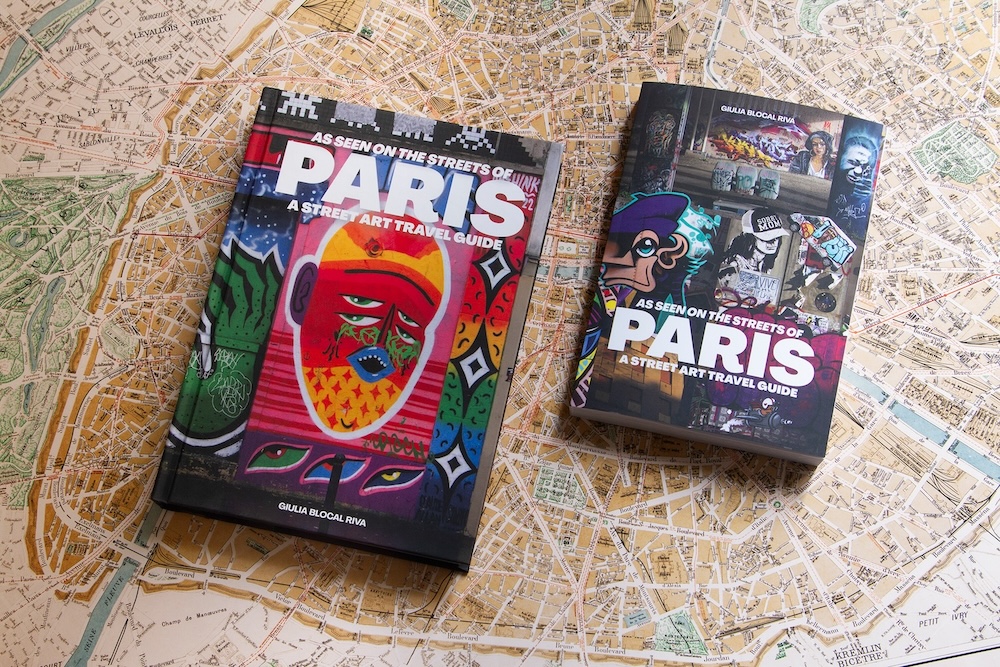
About the series As Seen on the Streets of…
Blending research, photography, and conversations with local artists, my self-published books invite you to see cities through the eyes of those who paint them. They take you into overlooked corners and reveal stories that rarely make it into mainstream narratives.
Each book is both a document and a companion, designed to help you read the city actively and explore beyond the beaten path at your own rhythm. Rather than flattening urban art into a polished, marketable image, these books hold onto its contradictions: illegality, ephemerality, and the constant tension with institutions and property. They do not sanitize — they amplify the voices that are too often left out.
While many publications reduce street art to a catalog of murals, detached from their context, my books resist that simplification. They capture the friction as much as the beauty, the temporary as much as the monumental. They ask you to notice what is usually left outside the frame: the contested, the fragile, the traces of a culture always at risk of being erased or appropriated.
They also confront how urban creativity is bound up with urban change: how murals can attract cultural capital, how graffiti is erased in cycles of regeneration, and how artists themselves are caught between visibility and exploitation.
Because looking at street art without these dynamics would be to misread the city entirely.
What they’re saying about “As Seen on the Streets of…”
“I’ve met, curated, and worked with literally hundreds of street artists over the last 25 years. And for every artist, there’s been a handful of supporting actors, bloggers, photographers, writers, academics, journalists, filmmakers, vloggers, the list goes on. People caught up in the passion and revolutionary potential of a democratised public art form, where individuals from all walks of life have the opportunity to stake their place in a movement that offers alternatives to the traditional networks of power that define and shape a city, and, by extension, the people who inhabit and move through it.
The same can be said of specialised fields, including publishing, hence the surfeit of cash-grab “street art” books, often produced with little knowledge of the scene, designed as city guides offering tourists a “splash of colour.”
But this, this book, is different. This is a book with heart, from the soul, written by an author who recognises the core tenets of what makes “street art” such a powerful movement and medium. It wrestles back that which is in constant danger of being lost. Giulia has been a mainstay in the culture for over a decade, and it’s been an honour to witness how the culture has shaped her as much as her research and writing, in turn, have helped shape us.
Buy it, read it, reflect on it. This is street art.”
Martyn Reed, Founder Nuart Festival
You can read more reviews, blurbs, and press coverage on each book’s dedicated page.