Giulia Blocal
Malasaña is one of the most important neighbourhoods for street art in Madrid, with murals, graffiti and painted shutters scattered across its streets. I lived in Malasaña between 2004 and 2006, just as street art was beginning to take hold in the neighbourhood. This article is therefore not only a guide to the street art you can still find here today, but also a look back at the underground movements, squats and artist studios that shaped Malasaña during the years when urban art was emerging in Madrid and gradually spreading from these streets to the rest of the city.
- Malasaña Before Street Art: Graffiti and Nightlife in the 1990s
- Noviciado 9: The Studio That Changed Madrid’s Street Art
- Patio Maravillas and the Squat Culture of Malasaña
- The Experiments of 3ttman in the streets of Malasaña
- The War of the Shutters
- Pinta Malasaña and the Institutionalisation of Street Art
- Malasaña Today: Between Street Art and Gentrification
- Where to see street art in Malasana
- My Interactive Street Art Map of Madrid: Murals and Street Art Locations
- How to use my Madrid Street Art Map
Malasaña is the favourite neighbourhood of Madrid’s night owls. Generations of young people have filled its bars and clubs, and for a long time also its streets with massive botellones. Malasaña is also a cultural hub and was the setting for the explosion of urban art in the 2000s. Here the squat Patio Maravillas and the artists’ workshop Noviciado 9 emerged, and the groundbreaking experiments of the French artist 3ttman took place.
Everyone passes through Malasaña to shop during the day or to drink at night, a flow of people that has always made the neighbourhood the heart of the most street level graffiti and street art.
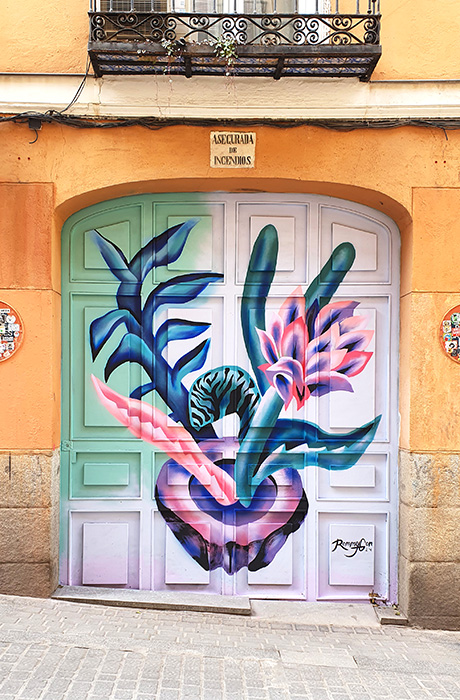
Malasaña Before Street Art: Graffiti and Nightlife in the 1990s
In the 1990s Malasaña was already one of Madrid’s most active nightlife districts and a meeting point for many of the city’s urban subcultures. Punks, rappers, grunge fans and all kinds of night owls mixed in its bars and squares, often turning the neighbourhood into a stage for demonstrations, clashes and long nights in the street. Graffiti writers were part of this scene. Every weekend they travelled from different parts of Madrid to buy paint in the city centre and spend the night drinking, painting and socialising. Malasaña’s walls gradually became a kind of open guestbook for Madrid graffiti. Through these practices Malasaña became closely linked to the emerging graffiti culture of Madrid, long before street art arrived in the early 2000s.
Noviciado 9: The Studio That Changed Madrid’s Street Art
In the mid-2000s an old building at Noviciado 9 became one of the most important hubs of Madrid’s emerging street art scene. The place was discovered by a group of artists looking for a large and affordable space in the city centre. The building, empty for almost twenty years, had neither water nor electricity and required extensive repairs, but its size, location, and cheap rent made it an ideal place for a shared studio.
Artists gradually adapted the space using discarded materials, turning it into a hybrid environment that functioned at the same time as a workshop, meeting point and living space. Eltono and 3ttman installed their homes there, while the rest of the building was divided into studios. The space quickly attracted other figures from Madrid’s growing urban art scene, including Nano Abia and visiting artists such as the French Remed.
During those years the studio functioned as an informal laboratory where artists experimented with new techniques and shared ideas while remaining closely connected to the streets of Malasaña. The project eventually came to an end when the building was sold in 2014, after several artists had already moved away. By then, however, Noviciado 9 had already played a decisive role in shaping the early generation of Madrid’s street artists.
Patio Maravillas and the Squat Culture of Malasaña
Another key space in the cultural life of Malasaña during the 2000s was Patio Maravillas, a squat created after the occupation of a former school building on Calle Acuerdo in 2007. Unlike many traditional squats, Patio Maravillas was largely run by university students. Their goal was to create an open space that combined political debate, cultural production and neighbourhood activities. Inside the building a wide range of initiatives took shape, from a bar and a hacklab to workshops, bicycle repair spaces and public assemblies.
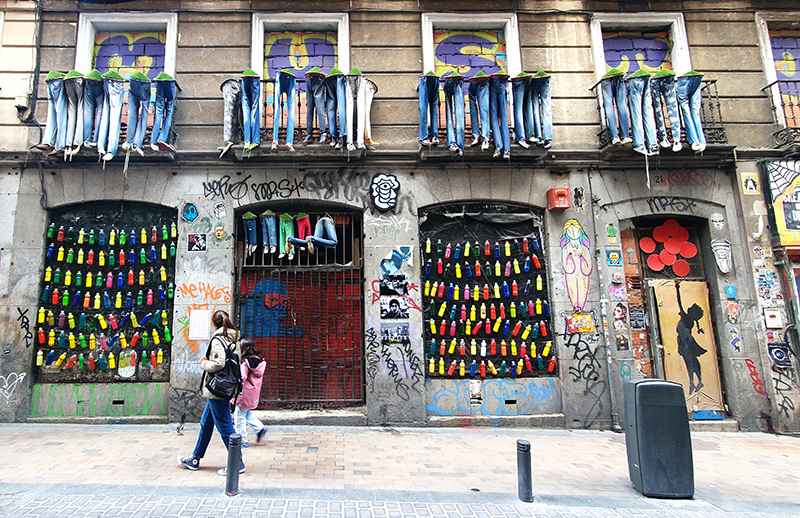
Urban art also played an important role there. The Trauma workshop became one of the founding projects of the centre and helped bring together several figures of the Madrid scene, including E1000 and Luzinterruptus. The space hosted events such as Madposter and Crítica Urbana, which turned the Patio into a key meeting point for artists experimenting with new forms of street intervention. The façade itself was painted in the style of German squats, without scaffolding and directly from the windows, while the interior was covered with posters and paste ups.
Patio Maravillas became an important hub for activism and urban culture in Madrid during the late 2000s, hosting assemblies and collective projects that later connected with broader movements such as 15M. After several relocations and increasing pressure from authorities and neighbours, the building was finally evicted in 2010, marking the end of one of the most influential self managed spaces in Malasaña’s history.
The Experiments of 3ttman in the streets of Malasaña
Among the artists active in Malasaña during the early 2000s, 3ttman stood out for his unconventional approach to working in the street. The French artist, whose real name is Louis Lambert, arrived in Madrid in 2002 attracted by the city’s lifestyle and settled in the neighbourhood. 3ttman began experimenting with new ways of working in public space, such as painting over advertising posters that accumulated on walls around the city centre. Together with artists such as Momo, Sixe, Zosen, Sins and Suso33, he produced dozens of these works in Malasaña and along Gran Vía.
3ttman also experimented with painting openly on the shutters of closed shops, protecting the pavement with cardboard so the action resembled legitimate decorative work. This strategy allowed the artists to operate without hiding and sometimes even to talk calmly with police officers who approached them. Later, 3ttman developed another unusual method by using fresh cement to leave drawings and messages on walls or to fill holes in the pavement, creating marks that remained visible even after graffiti was removed.
The War of the Shutters
In 2011, the Catalan company Rebobinart organised an event inviting artists to paint the metal shutters of shops in Malasaña. The initiative, promoted together with the local newspaper Somos Malasaña, offered shopkeepers free decoration while giving artists the chance to work legally in the city centre. More than a hundred artists participated, and many shutters across the neighbourhood were transformed in a single day.
The reaction from graffiti writers was immediate. Within a few nights many of the newly painted shutters were covered again with quick tags and throw ups. The dispute revealed the tension between two different visions of urban art in the neighbourhood: one rooted in the illegal traditions of graffiti writing, and another increasingly supported by cultural initiatives and local businesses.
Pinta Malasaña and the Institutionalisation of Street Art
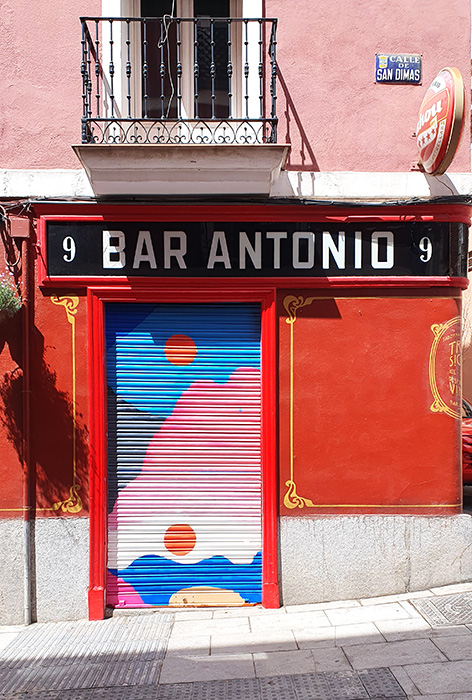
A few years after the first shutter painting experiment, the idea returned in a more organised form. In 2016 the event was relaunched under the name Pinta Malasaña, organised by Madrid Street Art Project together with the local newspaper Somos Malasaña. Once again more than one hundred artists were invited to paint the shutters of shops across the neighbourhood, turning the streets into an open air gallery for a day.
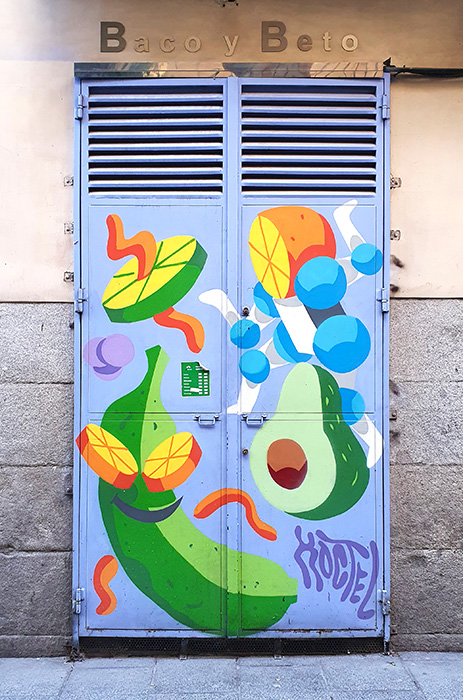
The festival attracted a large public and received wide media coverage, quickly becoming one of the most visible urban art events in Madrid. The festival is still active and each edition brings together artists from Spain and abroad, who submit proposals to paint specific shop shutters. Pinta Malasaña has continued to grow and today attracts tens of thousands of visitors, becoming a central event in the contemporary street art landscape of Madrid.
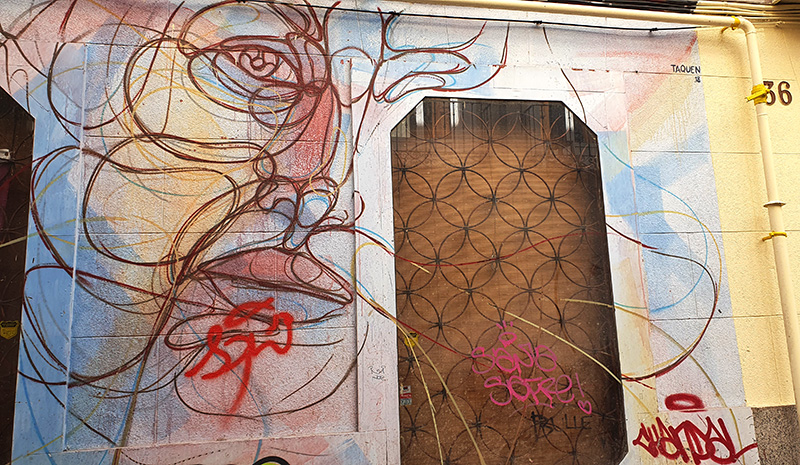
Malasaña Today: Between Street Art and Gentrification
Over the past two decades Malasaña has undergone a profound transformation. After years marked by nightlife excess, street drinking and a rough reputation, the neighbourhood gradually became one of the most fashionable areas of central Madrid.
Although the financial crisis of 2008 halted some of the real estate projects attempting to reshape a degraded section of the neighbourhood into a more commercial and attractive area, the transformation of Malasaña continued. Alternative venues and small neighbourhood businesses slowly gave way to trendier bars, restaurants and shops. New nightlife formats also appeared, including the so called barras de degustación, which allowed entrepreneurs to open bars in premises without the traditional infrastructure required for hospitality licences.
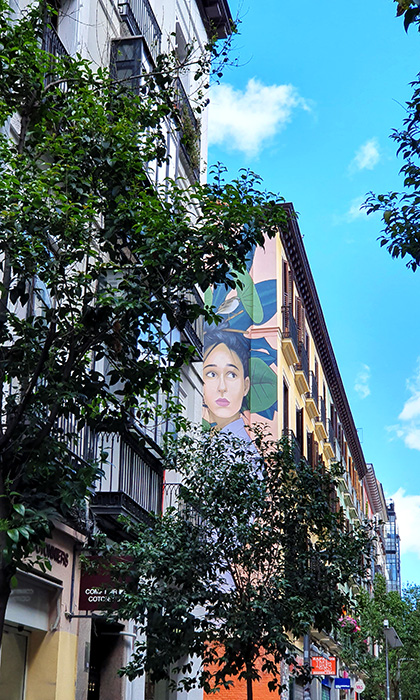
Urban art has remained part of the neighbourhood’s identity, but its context has changed. While Malasaña still attracts graffiti writers and street artists, the intensity of illegal bombing has declined as municipal cleaning has increased. Today the neighbourhood blends the traces of its graffiti past with a more polished cultural scene, where festivals, murals and nightlife coexist with the ongoing pressures of gentrification.
Where to see street art in Malasana
Although Malasaña has changed significantly over the years, it is still possible to encounter street art while walking through its streets. One of the most characteristic surfaces for urban art in the neighbourhood are the shutters of local shops, many of which are painted during the annual Pinta Malasaña festival. These works appear across several streets and are especially visible early in the morning, before the shops reopen.
Some of the streets where painted shutters and small interventions are more commonly found include Calle del Pez, Calle de la Palma, Calle Espíritu Santo and the area around Plaza del Dos de Mayo, the historic heart of the neighbourhood’s street life. Because Malasaña has long been a meeting point for graffiti writers, tags and throw ups also continue to appear across walls, shutters and doorways, even though many works disappear quickly due to cleaning or repainting.
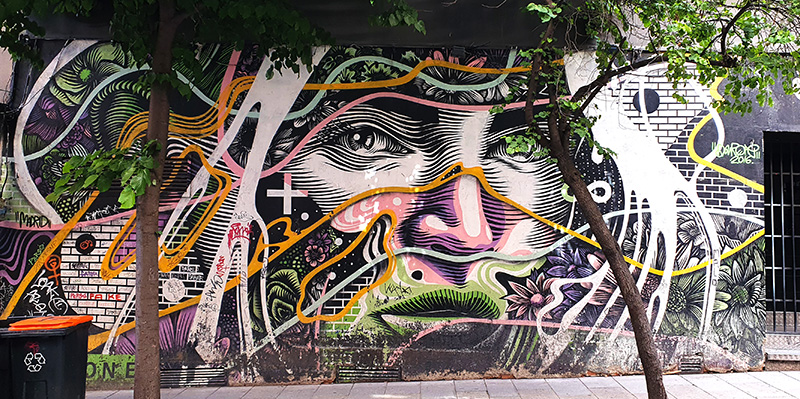
In recent years several large scale murals have also appeared in the neighbourhood. Among the most visible are works by Dourone, two murals by Boa Mistura, the Madrid collective that helped bring the city’s street art scene to international attention, and two large pieces by Artez and Helen Bur, both produced in collaboration with the urban art fair UVNT Art Fair.
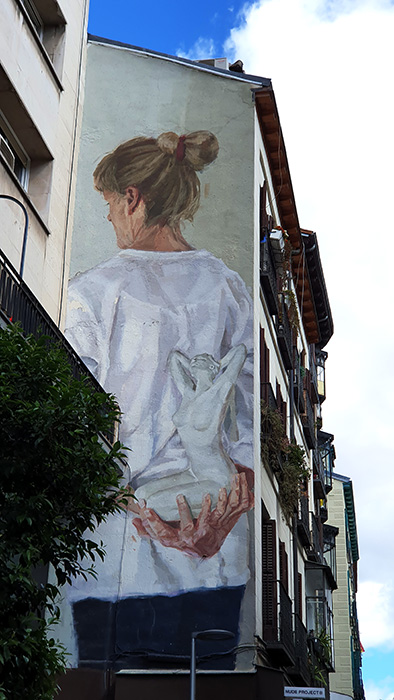
Today Malasaña remains one of the most emblematic places to understand the history of street art in Madrid. From the graffiti writers who filled its walls in the 1990s to the artist studios of Noviciado 9, the squatted spaces of Patio Maravillas and the murals that appear during events such as Pinta Malasaña, the neighbourhood has played a central role in the development of Madrid’s urban art scene. While Malasaña has changed dramatically over the years, its streets still preserve traces of the underground culture that helped shape street art in the city.
My Interactive Street Art Map of Madrid: Murals and Street Art Locations
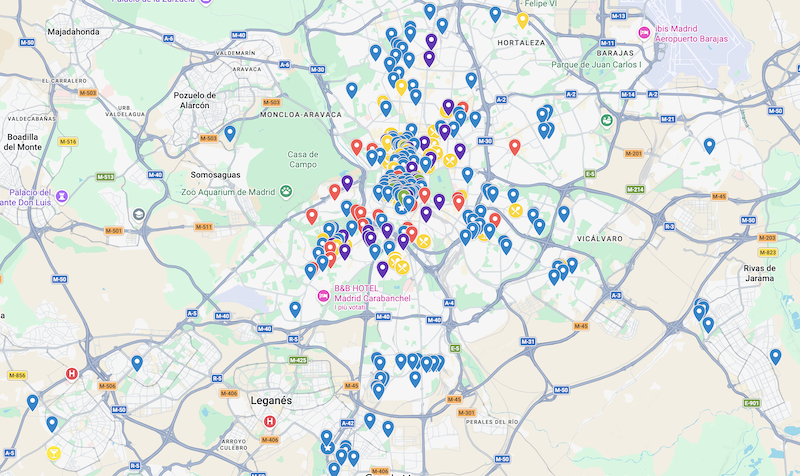
Malasaña is only one part of Madrid’s street art landscape. Over the years I have mapped hundreds of murals, graffiti pieces and urban art spots across the city (and beyond!), alongside other cool urban spots and overlooked museums. The interactive map below collects many of these locations and is regularly updated as new works appear and others disappear. Use it to explore Madrid’s street art on foot and discover some of the city’s most interesting urban art districts.
Explore the interactive map below to find street art locations across Madrid and beyond, including Lavapiés, Malasaña, Villaverde, Carabanchel, and Fuenlabrada.
How to use my Madrid Street Art Map
It’s super easy! It’s a regular travel map on Google, so there’s no need to download any app or install anything on your phone. Subscribe to my monthly newsletter and you will receive a welcome email with the link to all my street art Google Maps. If you don’t see the email within ten minutes of confirming your subscription, check your Promotions folder or similar. It must be hiding somewhere 😉