Giulia Blocal
This editorial on buffing was originally published in my street art newsletter, Beyond the Walls, which lands in inboxes on the 1st of every month with reflections and unexpected finds. This excerpt is from the October 1st, 2026, edition. Subscribe here to receive future issues.
A Clean Wall Is Never Neutral.
Maybe it’s just my algorithmic bubble, full of Rome and graffiti, but every time I scroll through Instagram, the same man seems to appear on my screen. Valerio Tuveri has built a huge following by filming himself removing graffiti from walls around Rome, sometimes pairing the videos with deliberately provocative captions that predictably set the comment section on fire.
The format is simple and strangely compelling to watch: there is a wall covered in writing, then there is a clean wall. It is the classic before-and-after, one of those internet formats that somehow never gets old.
But today, I want you to look at that second image a little differently.
Is the wall really being returned to its original state, or are we simply looking at another intervention on the same surface?
Removing graffiti creates a new version of the wall rather than rewinding it to an earlier one. Whether the writing is painted over or physically treated, the surface changes again, often leaving a shift in colour, a faint outline or a different texture behind. The “clean” wall is therefore something actively produced, through a decision about what should disappear and an intervention that changes the surface in order to remove it.
The relationship becomes even more interesting when you look at the people on either side of it, because writing and removing are both sustained by repetition. In graffiti culture, getting up means making your name visible by writing it across the city again and again. Valerio’s activity follows a strangely similar logic. He is not a municipal graffiti remover; he intervenes independently, through self-initiated, repeated interventions. As he put it in an interview, “Writers make a mess, and I step in.”
I was reminded of this during my month of research in Berlin, when I spent an afternoon with a publisher specialising in graffiti books. He told me about someone working on a book about graffiti in Rome who had interviewed Valerio too, precisely because his activity belongs to the same cycle of repeated intervention on urban surfaces. At first, including the man who removes graffiti in a book about graffiti sounds almost absurd, but it starts making sense once you realise how much the two practices depend on each other.
Valerio is simply the most visible version of something far more ordinary. A lot of the buffing we see around cities is carried out by private citizens, often the building owners themselves, who buy a tin of paint and cover whatever has appeared on their wall. That also helps explain those oddly mismatched rectangles that seem to come in every possible shade except the one that was already there. 😂
Look at those patches for long enough and they become difficult to ignore. The buff has a visual language of its own: blocks of paint that almost match the wall, alongside ghostly outlines or altered textures where the original writing used to be. In their research on graffiti removal in Paris, Jérôme Denis and David Pontille document a term used by graffiti removers for the visible traces left by attempts to make a wall look untouched: “cleanliness stains1.” I love that expression because it captures the contradiction perfectly. The cleaner erases one mark and produces another, while the wall carries the history of both the graffiti and its removal.
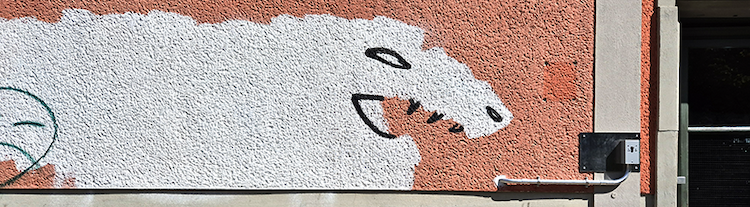
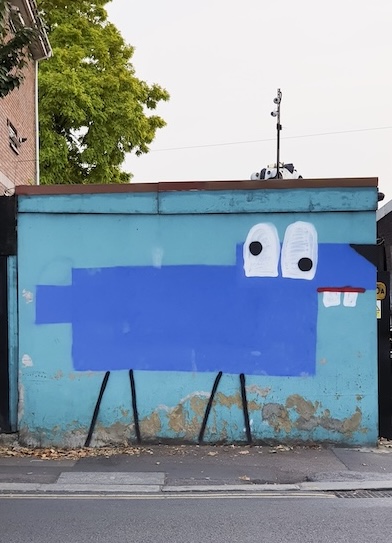
During the summer I spent in London researching the book, Paul Insect’s Buff Animals were among the most satisfying things I came across on my walks: a series of unsanctioned street works that turn the patches left by graffiti removal into small creatures, adding just enough to make you notice the shape that was already there. What I like most is how little he needs to add: the buff was already a shape, and a few details are enough to make that impossible to ignore. At that point, the rectangle or blob starts reading as another layer on the wall.
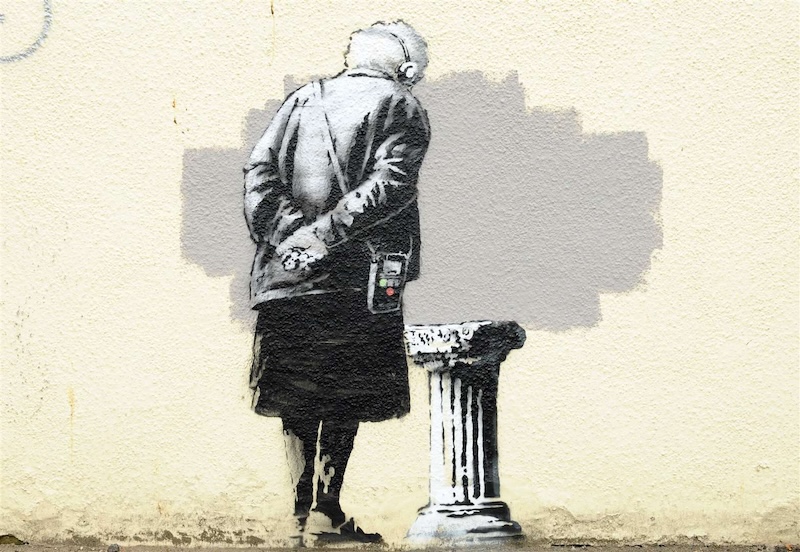
Seeing the buff as a layer also raises a more political question: which marks are we choosing to erase, and which ones are allowed to stay? Walk around cities with that question in mind and a pattern often emerges: quick name-based forms of graffiti, such as tags and throw-ups, are often removed or pushed into the background, while figurative street art tends to be treated with greater tolerance and remain on the wall for longer. So even the idea of a “clean” wall is selective. Sometimes cleaning means restoring a sanctioned mural after someone has sprayed over it; elsewhere it means covering the writing completely. Either way, someone is deciding which layer belongs to the accepted image of the city and which one should disappear.
Seen across time, all of this starts to resemble a conversation, with each action changing the wall for whatever comes next. The clearest, almost surreal example comes from street artist Mobstr, who turned that back-and-forth into the work itself on the streets of London in 2014. I’m leaving you a video of the intervention because it shows better than I could explain how unstable the boundary between making and erasing can become: the cleaner, trying to make the graffiti disappear, ends up participating in the image. Watch it until the end: Mobstr saves the best line for last. 😂
- Jérôme Denis, David Pontille. The Material Politics of Graffiti Removal. Visual Anthropology, 2024, 37 (4), pp.354-375. ↩︎