Giulia Blocal
This editorial on Berlin is just me starting to untangle some fresh impressions from my month in town, researching the upcoming book in the As Seen on the Streets of… series.
It was originally published in my street art newsletter, Beyond the Walls, which lands in inboxes on the 1st of every month with reflections and unexpected finds. This excerpt is from the September 1st, 2026, edition. Subscribe here to receive future issues.
This month, I’ve stepped away from the usual newsletter format and instead shared some open questions and observations drawn from interviews with Berlin-based street artists and conversations with friends who live here, alongside thousands of kilometres walked through the city following my intuition.
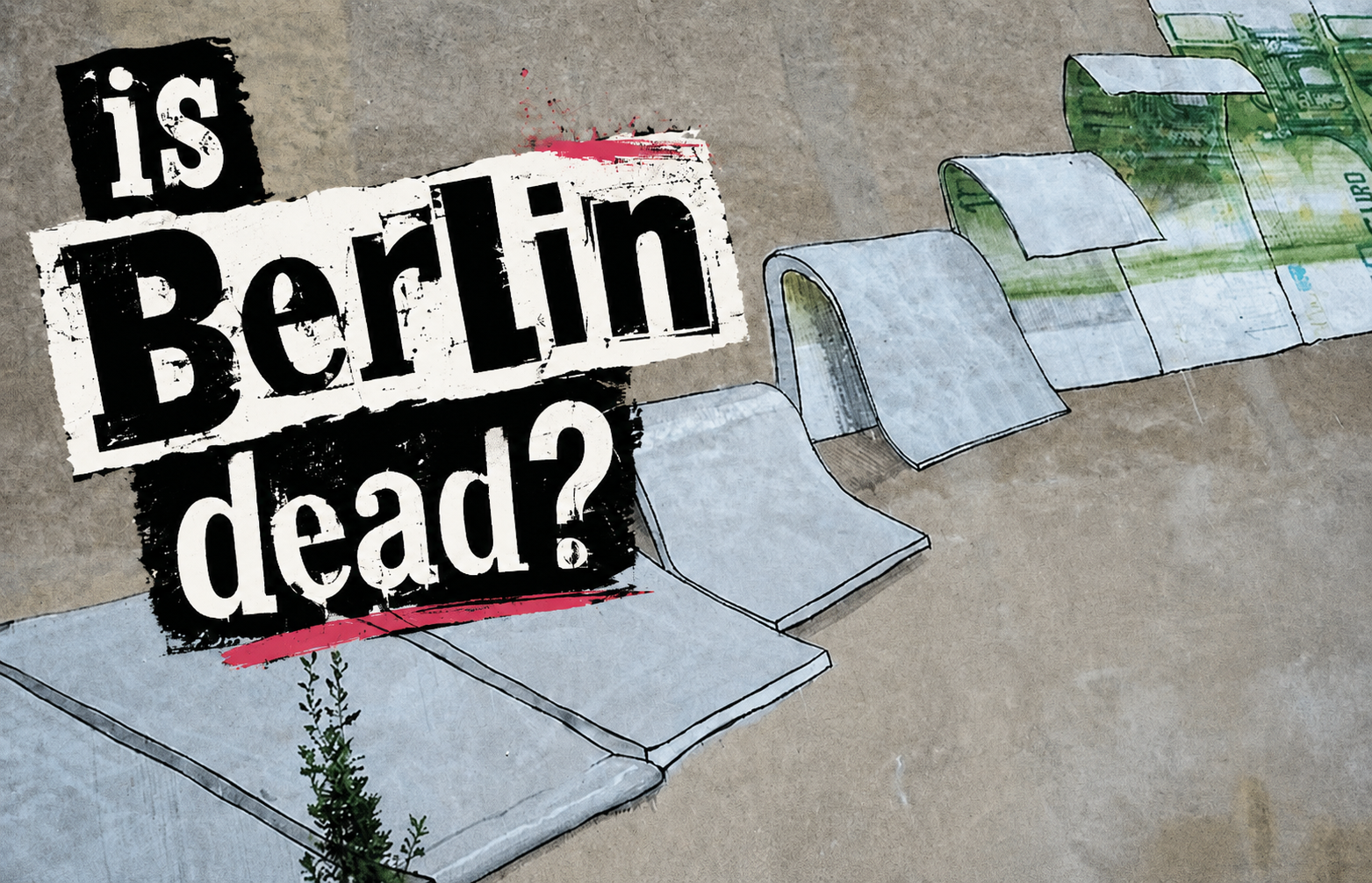
The moment I arrived, I heard it. It was the same sentence I was told 10 years ago, and five years before that, and yes, even on my first visit back in the 2010s. “Berlin is dead, there’s nothing to see here anymore.” Apparently, Berlin has been dead for a very long time.
And yet, we decided to dedicate the fourth volume of our street art book series, As Seen on the Streets of…, to Berlin (the third one is about Lisbon, and it will be out soon-ish, or as soon as we come back from Berlin and finalize the last details). And so we came here at the beginning of August to dive into the first phase of research, which in practice has meant walking until my feet hurt, interviewing many Berlin-based artists, photographing walls and updating a colour-coded Google Map that seems to become obsolete almost as quickly as I can organise it. A mural disappears, a former cultural space becomes offices, a place everyone says has been saved turns out to have bought itself only a few more years. Then, just when I think I am beginning to understand the pattern, I find something unexpectedly alive.
Along the way, that sentence kept following me around the city: “Berlin is dead.”
I heard it from people who arrived here in different decades, from people who remember the empty spaces after the Wall came down, and from people who still choose to live here every day. I heard it so frequently, not only on this trip but across my many previous trips to Berlin, that I decided to turn it around and ask it directly to the artists I’m interviewing for the book and to friends who live here, usually over beers: “Is Berlin dead?”
One artist was told Berlin was dead when he arrived in 2008. Another heard exactly the same thing when he moved here in the late 1990s. In 2026, people are still saying it.
Apparently Berlin has developed the unusual ability to die repeatedly without ever quite vacating the premises, and so this past month I stopped wondering whether Berlin was dead and started wondering what, exactly, everyone thought had died.
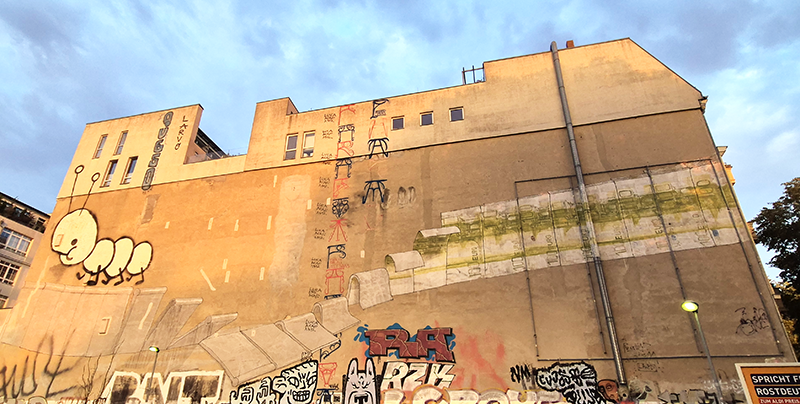
We talked about why his other Berlin murals disappeared in the previous newsletter, so if you missed that story, you can catch up there.
How long has Berlin been dead?
When I started asking the question directly, the chronology became increasingly confusing. WESR, a Peruvian-born artist who has lived in Berlin since 2008, remembers being told almost immediately that Berlin was already dead. When I mentioned this to Various and Gould a few days later, a Berlin-based artist duo whose practice grew out of illegal poster interventions in the streets, one half of the duo laughed: he had heard exactly the same thing when he arrived at the end of the 1990s. At some point we started joking that Berlin had apparently been dying for almost forty years, until he observed that being on the way towards death is, technically, what being alive means.
Pascal Feucher, the French owner of Urban Spree, was much less philosophical about it when we met him at RAW a few days ago. In his version of the story, Berlin’s particularly fertile period for street art lasted until roughly the middle of the 2010s, when international artists were still regularly coming through the city and projects such as Backjumps helped create a scene that felt connected to what was happening elsewhere. He sees what came afterwards as a decline, with Covid delivering the final blow, and when he finished describing the artists who no longer move here and the cultural infrastructure he feels has disappeared, he looked at us and said, almost apologetically, “Sorry if I depressed you, but that’s how it is.”
What started to interest me was how confidently people could declare Berlin dead while referring to completely different moments in its history. For someone who arrived in the late 1990s, the lost city might be the one of empty buildings and spaces that could still be appropriated with very little money. Someone else might be mourning the street art scene of fifteen years later, while another person is thinking about clubs, rents or the possibility of living here as an artist at all.
Before deciding whether all this was simply Berlin’s unusually persistent form of nostalgia, needed to understand what had actually disappeared.
What exactly do we lose when a city changes?
During one of my interviews, Damian Yves Rohde (the Berlin-born artist also known as Wand Brand) told me that he cried when the Berlin Wall came down. He was a child and understood very little of the politics surrounding it; what he understood was that the Wall had always been there, a monument he had grown up with and was used to seeing as part of his city. In his words, it was simply “my wall,” and suddenly it was disappearing. I kept thinking about that because it complicates the way we usually talk about urban change: even a transformation celebrated as liberation can contain a very personal sense of loss for someone whose familiar landscape is being dismantled in front of them.
Amigo, a Turkish-born b-boy and choreographer who was part of Berlin’s early hip-hop scene, remembers the Wall from almost the opposite perspective. He could not understand why a city was divided in two in the first place, and even after it fell his parents initially forbade him from going to the other side. Eventually, he and his friends started exploring what had been East Berlin, finding ruins and vast empty spaces that were soon being occupied by parties and independent cultural projects. Those spaces became part of the Berlin that many people I have spoken to still remember as unusually open to experimentation, simply because so much of the city had yet to acquire a fixed purpose.
German artist Jim Avignon, who arrived in the city before the Wall came down and became closely involved with the emerging rave scene, encountered that freedom through those early parties. He told me about painting inside abandoned factories where parties were being organised, sometimes working high up on a wall while people danced below and occasionally looked up to see the image taking shape. The spaces were dark, which is one reason his paintings at the time were largely black and white, and the organisers were simply happy to have someone painting the walls while everything around them was still being invented.
That Berlin is genuinely difficult to recreate today, because the empty buildings and cheap space that made so much spontaneous activity possible have largely disappeared. And yet, walking around the city now, I keep finding their visual language everywhere, sometimes preserved long after the conditions that created it have changed.
Can a city preserve the look of a culture after the culture itself has changed?
One of the things I have kept noticing during this research is how often the visual language of Berlin’s alternative past survives after the function of a place has changed almost completely. At Fabrik23, for example, I found the industrial architecture and traces of old murals I had been hoping for, but the former factory is now largely occupied by private studios and event spaces, and the afternoon we visited there was a corporate mixology class happening in the canteen. Over a more-than-decent Berlin pizza, my friend Zuleika’s boyfriend Matteo described places like this as selling the “smell” of the old alternative Berlin rather than its essence, which stayed with me because it captured something I had been struggling to articulate.
Tacheles is perhaps the clearest example. The former occupied cultural centre is now home to Fotografiska, yet some of the painted walls from its previous life have been preserved, including the very first mural by Argentinian-born Berlin-based Caro Pepe. When I interviewed her, she told me that moving to Berlin was also the moment she left a career in marketing to become an artist, which makes that early work feel particularly tied to the kind of possibility the city -and Tacheles itself- once represented. Sara Manfredi, curator of the Italian street art festival CHEAP, put the transformation much more brutally when I met her for a beer one afternoon: “They even sold the corpse.” She meant that instead of clearing the site completely and starting again, the redevelopment kept some of those painted remains and incorporated them into the new cultural complex. The walls that once belonged to an occupied space now help give character to a very different kind of institution, so even the remnants of the old Tacheles continue to produce value. Can you smell alternative Berlin yet?
Kera1, a Berlin-born artist whose first studio was inside Tacheles, experienced that place from a very different position. He worked there for years and was still there on the final day, when everyone had to leave the building, although he has never been back since the Fotografiska redevelopment. He remembers it simply as a great period when “so much was going on,” and when he passes the site today he has no doubt that the old spirit is gone.
I had a similar feeling at KulturBrauerei, where Emilia, a friend who grew up in Berlin but now lives in Morocco, tried to describe what the former brewery had felt like when it was still a much rougher cultural space, while I stood there looking at its beautifully restored courtyards and trying to imagine the version she remembered. The buildings are still there, and in some cases so are the marks associated with their earlier lives, but the social function around them has shifted.
The most personal example for me was a rooftop in Neukölln that I had loved about ten years ago, when you could drink a beer among street art, pallet furniture and tomato plants. This time I found a €7 entrance fee, Photoautomat booths and pop-alternative props where I remembered the plants.
Holzmarkt gave me a similar feeling. I had expected an informal creative space by the river and instead found something closer to a Christmas market, with rustic-looking signs directing people towards food and shops, while much of the street art was pushed into the background.
What makes this more than a collection of disappointing revisits is the role this aesthetic still plays in Berlin’s city branding. The city continues to benefit from an international image built around creative freedom and a certain roughness, with graffiti and former industrial spaces helping to signal the Berlin people expect to find before they even arrive. That image has enormous cultural and economic value, even as some of the conditions that originally produced it become harder to sustain. And this is where the conversations I have been having with artists start to move the question away from how Berlin looks and towards what it actually means to live and work here as an artist.
How easy is it to be an artist in the city of artists?
The contradiction becomes harder to ignore once the conversation moves from Berlin’s image to the material conditions of being an artist here. When I interviewed Various and Gould, they spoke about cuts to cultural funding and a political climate in which art increasingly feels peripheral. In their view, the Berlin imagined by many politicians today is a city of start-ups and tech, while artists are still too often treated as people indulging a hobby rather than doing a job. When I asked whether culture was at least part of the current election debate, they laughed: barely. One of them then made an observation I have kept thinking about. If art and culture were really so unimportant, authoritarian regimes would hardly spend so much energy trying to control them.
Kera1 gave me a particularly concrete measure of that change: after spending his entire life in Berlin, he is now considering moving farther into the countryside, partly because it would allow him to own a larger studio instead of dealing with the increasingly prohibitive cost of working space in the city.
The private market offers little reassurance, as pointed out by German artist Sokar. He described the city as relatively poor compared with places such as London or New York, where there are more collectors and more money circulating around contemporary art. Snyder, a Berlin-born artist with roots in graffiti, gave me an even simpler version of the problem when we were talking about mural commissions: the attitude is often, “I’m already giving you the wall.” The wall itself is treated as compensation, as if the opportunity to paint in Berlin should be enough.
WESR explained why that model can continue to function. Berlin has a constant turnover of young artists who arrive for a few years, build a portfolio and are willing to paint for free because the “Berlin years” themselves become an investment in whatever comes next. When they leave, they can say they painted murals here. For artists who actually stay, pay rent and try to build a sustainable life in the city, that creates a difficult market because there is always someone willing to accept exposure instead of a fee.
Pascal, at Urban Spree, pushed the argument one step further. In his view, young artists are no longer moving to Berlin in the same way because the city has become too expensive, while some young Berliners are leaving for cheaper parts of Germany. He also sees the weakness of the local ecosystem in the lack of specialised galleries and bookshops, especially when he compares Berlin with Paris, where he is originally from and where, he says, that infrastructure is much more developed.
This is where the question of whether Berlin is “dead” starts to feel less like a joke about nostalgia and more like a question about oxygen. A city can continue to benefit from the image of creative freedom for a long time, but that image becomes harder to sustain when the people producing the culture behind it find it increasingly difficult to remain.
The complication, though, is that the people remembering an earlier Berlin have changed too.
Are people mourning Berlin, or their own youth?
The complication is that the people remembering an earlier Berlin have changed almost as much as the city around them. Snyder, who was born here and has never wanted to live anywhere else, was one of the least nostalgic artists I interviewed. Berlin changes, he told me, and it will continue to change regardless of how anyone feels about it. He also pointed out something deceptively obvious: the people who lived through the poor but sexy years twenty years ago are twenty years older now. Some have children, and artists who once experimented without thinking much about money eventually reach a point where their work needs to pay the rent.
Sokar described that shift through his own life. He used to live in Neukölln, until having kids changed the way he experienced one of Berlin’s most alternative neighbourhoods and, more broadly, what he wanted from the city around him. His studio is now in Friedenau, a much calmer and less alternative part of Berlin, and after our interview he insisted on walking us around the area, past elegant houses and an immaculately maintained park that made him joke that it almost felt like England. “When you have children, you start seeing the city differently,” he told me, which felt less like nostalgia for the Berlin he had left behind than an acknowledgement that the city you want can change as your own life does.
Emilia, a Berlin-born friend I spent an afternoon with in Prenzlauer Berg made essentially the same point from another direction. She moved away seven years ago and now returns mostly to see family and friends, and as we walked through beautifully restored streets she kept pointing out buildings and courtyards that reminded her of the Berlin she grew up in. She misses that city, she said, although she is no longer entirely sure how much she misses Berlin itself and how much she misses being younger in Berlin.
This reminded me of a book I read several years ago, La chiave di Berlino by Italian writer Vincenzo Latronico, who has lived in Berlin for years and whom everyone suddenly seems to have discovered recently. Latronico reflects on how quickly Berlin changed during the same years in which his generation was moving from youth into middle age, and on how difficult it becomes to separate what has genuinely disappeared from what we miss because we experienced it at a particular moment in our own lives.
Innerfields, a Berlin-born artist duo, pushed this idea even further when I asked what they thought of the familiar claim that it is now “too late” for Berlin. “We were too late too. We have always been too late. If you want to be too late, you can always be too late.” For them, even the fall of the Wall created a clear before and after, and there were already clubs and moments they felt they had missed. As they put it, you can always be too late if you remain attached to what came before.
That attitude also feels consistent with their work, which explores the tension between our place within nature and the growing distance from it created by an increasingly mechanised world. Technology is something they question while continuing to experiment with it themselves, rather than treating the past as an automatically preferable alternative.
The useful thing about this perspective is that it does not make the losses imaginary. The empty spaces disappeared, rents rose and the economic conditions that allowed a particular kind of cultural experimentation became harder to reproduce. At the same time, the person remembering a night spent in an abandoned factory at twenty-five may now be looking for a quieter apartment and wondering whether the work they once did for free can finally pay a mortgage. City and biography keep moving together, which makes it surprisingly difficult to determine where nostalgia for one ends and nostalgia for the other begins.
And then there are people whose relationship with Berlin makes that distinction even harder, because the version of the city everyone seems to be mourning was never the reason they came here in the first place.
Which Berlin are we actually mourning?
WESR complicates the nostalgia argument even further because the Berlin many people seem to mourn was never the Berlin he came looking for. He moved here from Peru in 2008 for family reasons, and shortly after arriving someone told him the city was already dead. What makes his story interesting is that he did not arrive with any particular mythology attached to Berlin, and for a long time he did not even like living here very much. Only gradually, especially from around the pandemic onwards, did he begin to appreciate what the city offered him and, as he put it, “make peace with Berlin.”
What he eventually came to value was less the image of abandoned buildings and underground clubs than the freedom of everyday life. He talked about the work-life balance people protect here and, above all, about the feeling that Berlin does not judge you. At one point he told me about seeing what looked like a television moving towards him on the opposite escalator, only to realise that it was a person wearing a TV over their head, dressed in full rockabilly style. His reaction was simply: “Of course. This is Berlin. If not here, where?” He also pointed out that people arriving today may be looking for something completely different from those who came in the 1990s. Someone moving to Berlin now for a job in tech might genuinely love the city as it is, and might have had very little interest in the version others are mourning.
I heard something similar from Various and Gould. The Berlin he encountered when he arrived at the end of the 1990s, with its empty spaces and possibilities for spontaneous cultural use, has obviously changed, yet he told me that he still chooses Berlin every day. The promise that brought him here was the possibility of becoming whoever he wanted to be in a city open-minded enough to allow it, and in his view Berlin still keeps that promise.
Jim Avignon was equally resistant to the idea that the cultural energy everyone remembers has simply vanished. When I asked whether the rave scene he had entered decades ago was dead, he said no. It had changed and become harder, but younger people were still organising illegal parties in parks and finding ways to create things outside formal structures. The scale and conditions are different, yet the impulse that produced so much of the mythology around Berlin has not disappeared entirely.
The more people I spoke to, the less useful it seemed to treat “Berlin” as a single thing that could simply be declared alive or dead. Some people were mourning cheap space, others a particular cultural scene, while others still cared most about a kind of social freedom that they believe survives. The physical city and the promise attached to it seem to be changing at different speeds.
What does a place have to do to still feel alive?
RAW was one of the places I was most curious to revisit because I had liked it on previous trips and several artists had mentioned it when I asked what was still left of Berlin’s alternative scene. It has changed, and of course there are tourists now, but when we went back I was struck by how much of the space was still being used rather than simply treated as a colorful backdrop for photos. People were skating or playing ping pong, while others were drinking, smoking or just hanging around for the afternoon. There was very little of the frantic selfie-taking I had found elsewhere (at the once-legendary Haus Schwarzenberg, for example), and for me that made an important difference. A place can change and attract visitors while still feeling alive, as long as it retains a life that exists independently from the people who arrive to consume its image.
A few days later, however, Pascal at Urban Spree complicated even that relatively optimistic reading. RAW has recently been described online as “saved,” but according to him what has really been secured is the future of Cassiopeia, the well-known club at the centre of the complex, while much of what surrounds it is still expected to disappear and be replaced by offices and apartments. His prediction was also bleakly practical: once people are living next door, a club that depends on loud music late into the night will inevitably face a different set of constraints, so Cassiopeia might technically survive while becoming something very different from the place people fought to save.
That distinction between preserving a place and preserving the conditions that allow it to function kept coming back to me, especially because I had spent much of this trip looking for independent spaces that still felt genuinely DIY rather than designed to reproduce a DIY aesthetic. Many were closed to the public outside sporadic events, and after a while the repeated sense of arriving at a closed door started to affect me more than I expected.
Then, last week, we went to Villa Kuriosum, a place I had found through my own digging rather than through recommendations from artists or friends in Berlin. The moment I walked into the garden, I knew I had finally found what I had been looking for: a DIY space that felt genuinely lived in rather than carefully staged to look alternative, and that somehow managed to feel open at the same time. After weeks of coming across similar places that understandably keep outsiders at a distance, even when that distance still stings a little, the absence of suspicion was almost a relief. There was a concert happening and, when the temperature dropped, someone lit a fire inside a metal barrel; before long, we were sitting around it with everyone else, simply part of the evening.
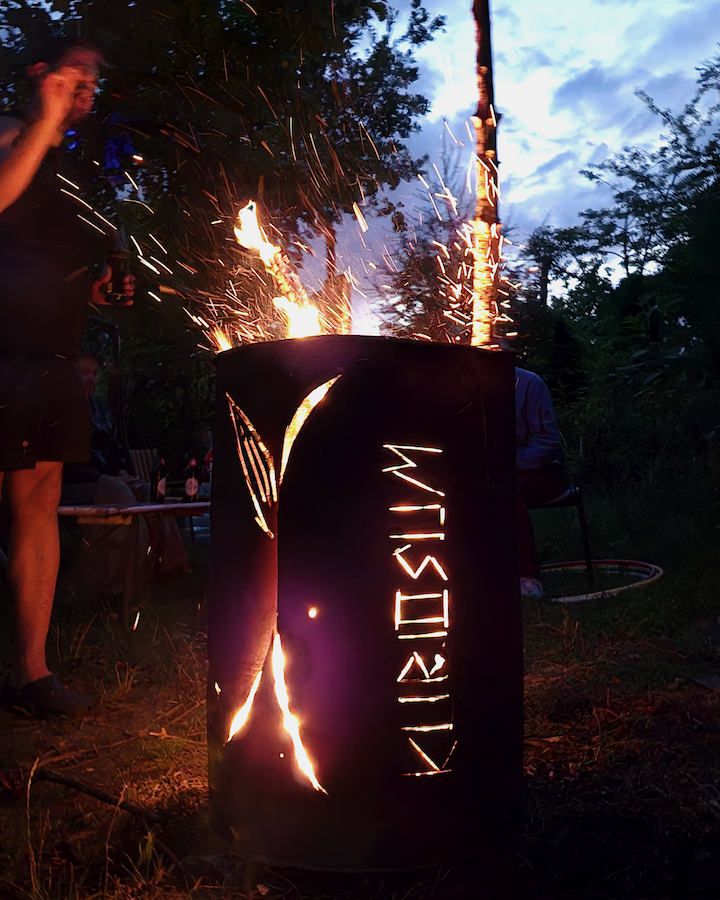
So, is Berlin dead?
After almost a month of asking the question, what worries me more than whether Berlin is “dead” is the growing distance between the freedom the city still promises and the material conditions required to sustain it. Berlin continues to benefit from its image as a place where artists can experiment and live differently, while many of the people producing that culture describe shrinking support, increasingly expensive space and a market that often expects them to work for exposure.
A few days after that evening, Prizmu, a stencil artist who has lived in Berlin since 2018, gave me another way of thinking about what had happened there. He told me he has little patience for nostalgic conversations about what Berlin used to be, because spending too much time looking backwards, or even forwards, can stop us from paying attention to the city we are actually living in. Standing around that fire, for once, that was exactly what I had done.
Perhaps this is also why his answer felt so close to the way we approach the As Seen on the Streets of… series. Each book includes a chapter reconstructing the city’s street-art history through research and conversations with the artists who lived it, but the rest is deliberately anchored in the present. We photograph what is there now, speak to artists who are active now and try to freeze one particular moment in the life of a scene that will inevitably look different a few years later.
There is already plenty of nostalgia surrounding Berlin; what interests me more is paying close enough attention to the present that one day we will know what was actually here.
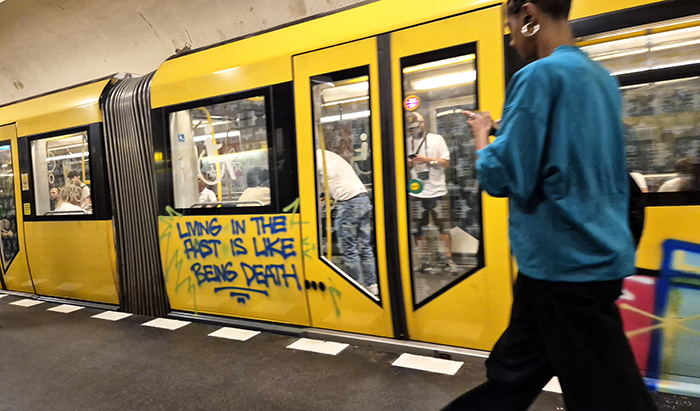
Photo taken on the first day of our street art trip with readers.