Giulia Blocal
I had been hoping to meet DULK for a long time, so when Dorothy Circus Gallery invited me to the opening of his new exhibition in Rome, Silent Encounters, I wasn’t going to miss the chance.
I’ve been following his work for years, especially his murals, and he even created his giant flamingo sculpture at STRAAT Museum just after I left, so somehow our paths had almost crossed before.
Dorothy Circus often invites me when an exhibition involves artists with roots in street art, which makes sense given the gallery’s own history. Founded in Rome in 2007, it was among the first galleries in the city to regularly bring artists from the street into an exhibition space. Over the years, however, the gallery has moved beyond those categories, developing a programme centred increasingly on the worlds its artists create, with a particular affinity for Pop Surrealism and other forms of surreal or dreamlike figurative painting.
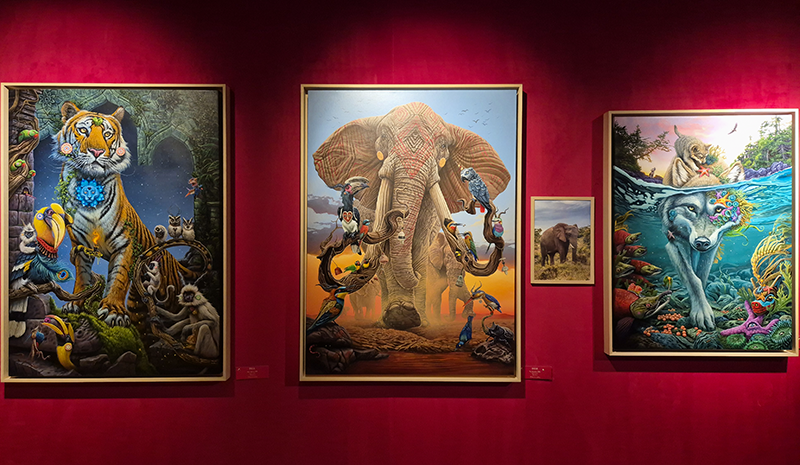
With his elaborate worlds populated by animals that are recognisable and strangely transformed at the same time, DULK fits naturally within this broader direction of the gallery’s programme. Born Antonio Segura Donat in Valencia in 1983, DULK moves between painting and large-scale murals, while Rome occupies a particular place in his story.
The first time I came to Rome was 11 years ago. My first international exhibition was here, and that’s also when I painted that mural. So I’m really happy to be back with another exhibition.
DULK
The mural he is talking about is still one of my favorite murals in the city! Eleven years later, DULK is back at Dorothy Circus with Silent Encounters, presented alongside Andrew Hem’s Family Business as a double solo exhibition.
The Art of DULK: From travelling to painting
The story behind Silent Encounters begins far away from the gallery walls, as travelling to see wildlife in its natural habitat has become an increasingly important part of DULK’s process over the past six years.
I’ve always loved animals and wildlife, but six years ago I realized how important it was for me to actually be in the places where these animals live, to experience them and feel something there that I could bring back with me and paint. So I started travelling to many different places, and the paintings in this exhibition are inspired by places I’ve visited recently.
DULK
The exhibition brings together memories from several of DULK’s recent journeys, with each painting taking him back to a different experience.
When I’m painting, I go back to that specific trip. I remember being there, the things I experienced, and through painting I translate those memories into another medium. It’s my art, but also my memories and my experiences in the place, all together in an image. It becomes a kind of window onto that place, but in a different way from a photograph.
DULK
Behind the paintings in Silent Encounters there is a real place, and often a real encounter, although what eventually appears on the canvas goes far beyond a record of what DULK saw while he was there. The experience stays with him as a memory, while the photographs he takes during his travels give him something tangible to return to once he is back in the studio, where both become part of a much more imaginative process of reconstructing the scene.
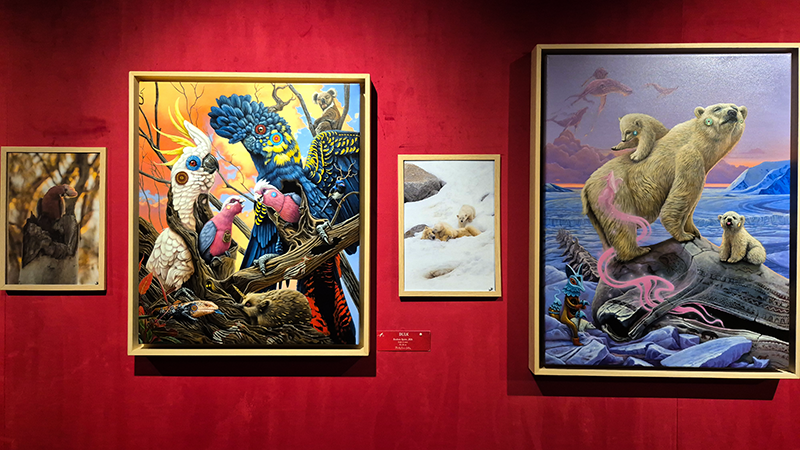
For the first time, Silent Encounters allows us to see part of that process for ourselves, as DULK has decided to exhibit some of his photographs alongside the paintings they helped inspire, making visible the distance between the moment he witnessed and photographed something in the wild and the image he eventually created from it.
There’s something in this exhibition that I’ve never done before, which is showing the photo that inspired me to create that painting. Sometimes I work from my own photographs, although I don’t always get exactly the image I need, maybe the animal isn’t in the right position, for example. So usually I put together a collage, a mix of images and photographs that I like, and I create the sketch from there.
DULK
One painting in particular makes that process very clear. It comes from an expedition to British Columbia with National Geographic, where DULK encountered one of the region’s coastal wolves. These elusive wolves live along the coast and feed on salmon and other marine life. They are so rarely seen that they are sometimes referred to as “ghosts.”
I remember I was in my room on the boat when the captain called and said, ‘There’s a ghost. Come to the bridge.’ So I went upstairs, and by the door there was someone going, ‘Shhh,’ telling me I could go outside, but I had to be completely quiet. I went out and I saw her. She was a pregnant female. It felt so special because I never thought I would actually see one. They’re so difficult to spot, and I was amazed that I had the chance.
DULK
DULK managed to photograph the wolf, but the image he eventually painted imagined her at another moment, accompanied by two cubs.
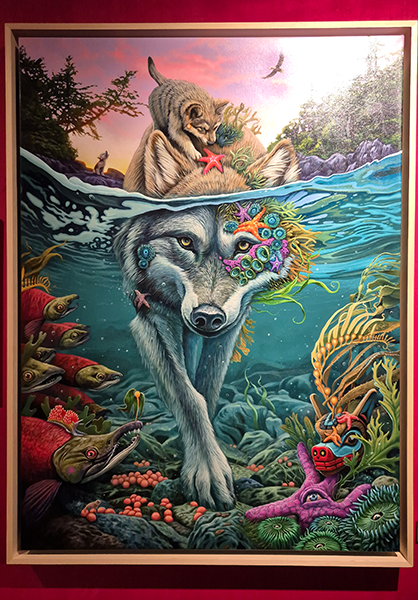
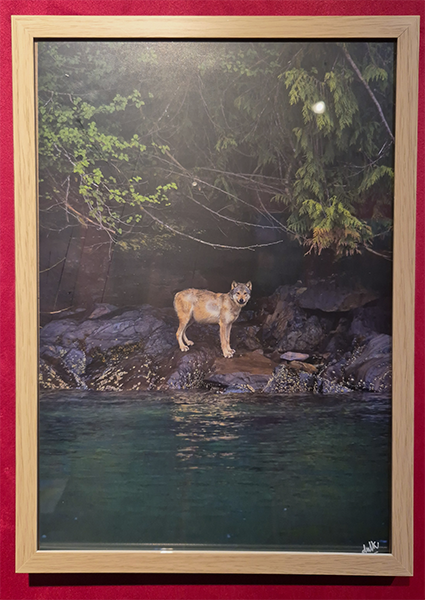
Because she was pregnant, in the painting I imagined her later with her two cubs, looking for food. That’s the kind of process I use: I take the photograph, but then I imagine the story of the character, perhaps at another moment in the future.
DULK
The real world inside DULK’s imaginary one
That small leap from an animal observed in the real world to the story DULK builds around it offers a way into his work as a whole, because however fantastical his creatures and their surroundings become, reality is never very far away.
My work is very realistic, but at the same time it’s very surreal. I like to keep that contrast at the heart of my style. When I was a kid, I really loved magical illustrations, imaginary worlds, fantasy places and things like that, and I’ve tried to keep that feeling in my work. It’s actually one of the main elements of my style.
DULK
The contrast DULK describes is one of the keys to understanding why his images work. His animals may inhabit impossible worlds and undergo strange physical transformations, yet they are rendered with enough precision to remain recognisable and strangely believable. The realism doesn’t compete with the surrealism; in many ways, it makes the surrealism more convincing. We recognise the anatomy and textures of a real creature, which makes the moment when reality begins to shift around it all the more unsettling.
Animals were already part of DULK’s world long before they began appearing on canvases and walls. As a child, he drew on old encyclopedias that had belonged to his grandfather, while his father kept an aviary filled with hundreds of canaries, goldfinches and greenfinches, giving him the chance to observe birds closely from an early age. At the same time, the magical illustrations and imaginary worlds he remembers loving as a child offered another way of looking at those animals, one in which observation could easily slip into invention.
Another important reference is Flemish painting, and it helps explain the extraordinary attention DULK gives to even the smallest elements of an image. His compositions reward a slower kind of looking, as the eye moves away from the main character and begins to notice smaller elements elsewhere in the image, some of which can become important enough to change how we understand the whole scene. Rather than offering a single image to decode, DULK builds up clues, allowing different stories and possible interpretations to coexist within the same work.
His drawing gradually moved beyond paper and into the street. DULK began painting walls around the age of nineteen, and although his practice has since expanded across painting, drawing, sculpture and photography, mural painting has remained an important part of his practice throughout that evolution. Moving onto walls also means taking an imaginary world built through tiny details and expanding it to an urban scale, where the viewer can enter it visually and discover those details gradually.
That is also the part of DULK’s practice I have followed most closely over the years. I had already encountered his work on walls in different Spanish cities, and one thing that has always interested me is how strongly his imaginary worlds can be rooted in the places where he paints them.
The surreal elements in my paintings come from the things I learn about a place and the things I want to communicate to the viewer. I learn as much as I can about each place, I talk to local people, especially biologists and naturalists, and I use all that information to create an imaginary story that, at the same time, is rooted in reality.
DULK
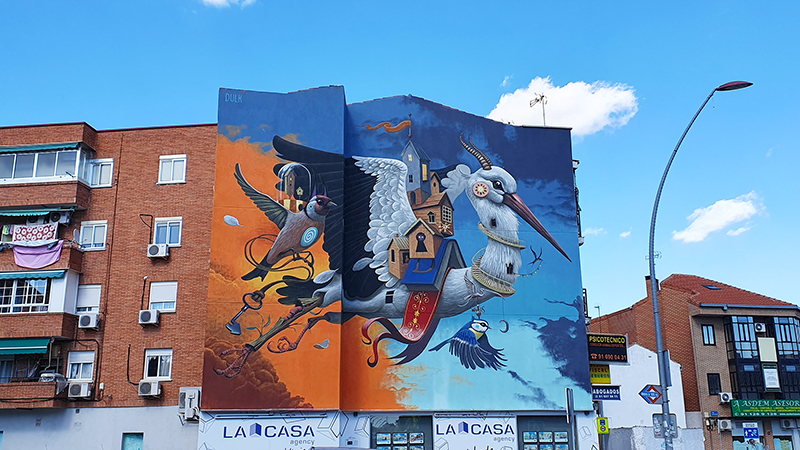
One of the walls I immediately thought about was Settled, in Fuenlabrada (Spain), where DULK placed a stork at the centre of one of his elaborate compositions. The choice makes much more sense once you know the local story behind it: storks had been successfully reintroduced to the area and their population had grown over the previous decade, so an animal that could easily be read simply as another inhabitant of DULK’s surreal universe was also carrying a very real story about what had been happening in that particular place.
Discover MAUF: Fuenlabrada Urban Art Museum
The animals in DULK’s murals are rarely generic symbols of “nature”, even when the image initially seems to belong entirely to fantasy. Knowing which species we are looking at and why that particular animal appears in that particular place can open up another layer of the work. The surreal narrative may be invented, but the clues embedded within it often lead back to something remarkably specific.
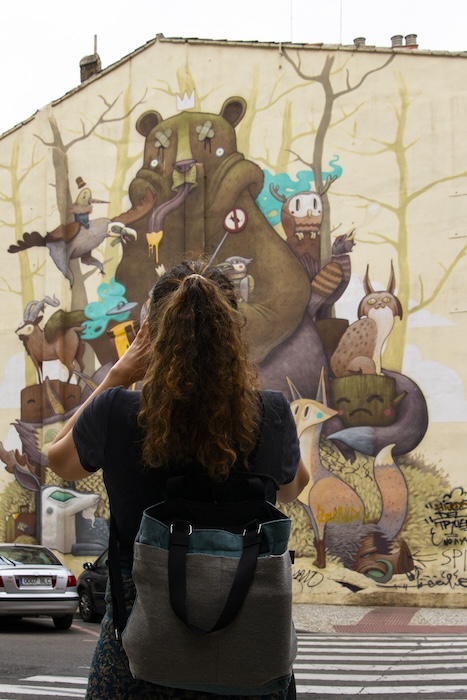
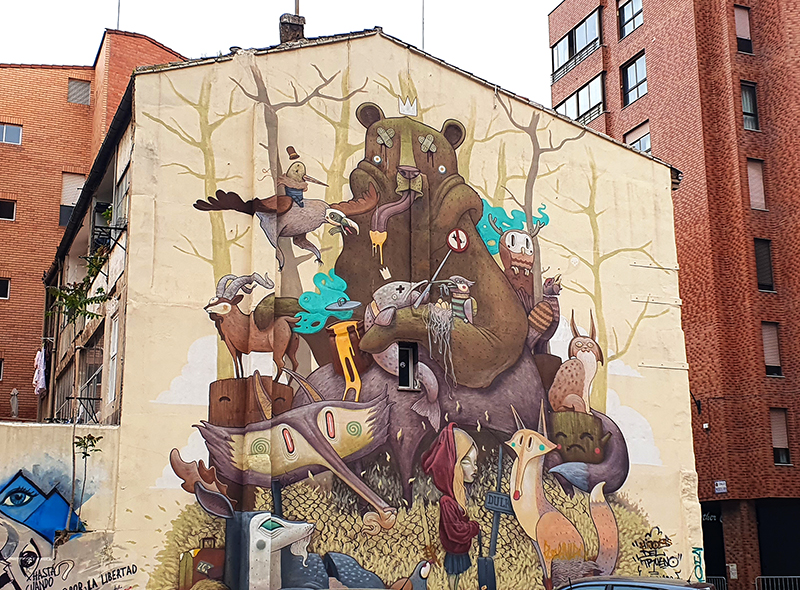
I had seen something similar in Zaragoza, although there the story was considerably darker. In Tribute to the Iberian Wildlife, recognisable animals from the Iberian fauna, including the brown bear, lynx, fox and partridge, share the scene with characters from fairy tales such as Little Red Riding Hood and the Wolf, emerging from a dying forest that points directly towards the pollution and destruction caused by humans.
By placing animals we can identify in the real world alongside those we have imagined and narrated for centuries, DULK allows the two versions to coexist within the same image. The wolf, in particular, belongs simultaneously to an ecosystem and to the world of fairy tales, where humans have given it an entirely different set of meanings, allowing DULK to move between an actual environmental problem and the shared stories through which we have learned to think about animals in the first place.
Exploring Zaragoza Through the Murals of Festival Asalto
DULK’s animals function as characters as much as carriers of meaning, something that became particularly clear to me when he described photographing the pregnant coastal wolf in British Columbia and then imagining a later moment in her life with her cubs. Elsewhere, their bodies can appear wounded or physically transformed, as though what is happening to the natural world has entered them. Even when they remain calm, there is often something strangely vulnerable about them: they seem to inhabit these damaged worlds rather than control what is happening around them.
The visual richness of DULK’s compositions draws us towards them first, while the more troubling parts of the story tend to reveal themselves gradually. What initially looks playful or dreamlike can gradually reveal damaged habitats or vulnerable species, sometimes through details that only become apparent once we spend more time with the image. Rather than approaching environmental urgency through straightforward images of catastrophe, DULK gives us something we want to look at and allows it to become more complicated the longer we stay with it, so that beauty and fantasy become part of the way we reach the more unsettling realities underneath.
Seen in this way, the relationship between the realistic and the surreal that DULK described to me is much more than a question of visual style. Reality supplies the species and habitats embedded in the work, while fantasy gives him the freedom to reshape them into narratives that would be impossible in the real world.
That environmental dimension has become increasingly prominent in DULK’s practice as his relationship with wildlife has grown more direct. The travels behind Silent Encounters are part of that evolution: going into the habitats of the animals he paints means seeing not only the animals themselves, but also the landscapes they depend on and the pressures those ecosystems are facing. That growing proximity to wildlife feeds directly into the recurring concern with vulnerable species and disappearing habitats across very different parts of his work.
The Art of DULK: Beyond the wall
As DULK moves between different media, the relationship between his imaginary worlds and the space around them changes with the scale of the work. A painting asks us to move closer and search through its details, while a mural enlarges those details until they become part of the city around us. In other projects, the creatures themselves seem to leave the flat surface altogether, becoming sculptural objects and monumental installations that physically occupy public space.
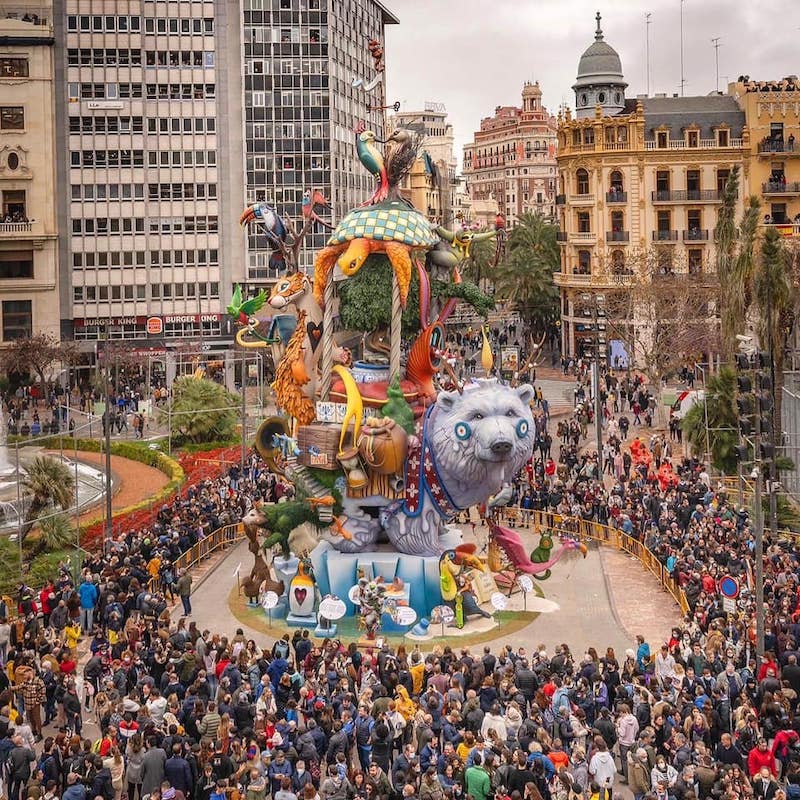
I had already written about one of DULK’s most ambitious public works in 2022, when he created Protect What You Love for Las Fallas, the patronal festival in his hometown of Valencia. At 23 metres high, the work moved far beyond the scale of a mural, bringing endangered and already extinct species together in a monumental installation built in the street, with its eventual destruction already embedded in the project: like the other Fallas monuments, Protect What You Love would ultimately be consumed by fire.
Seeing a work concerned with species we are losing take shape within a tradition built around disappearance gave the project an additional resonance. After weeks of construction, this enormous gathering of animals would exist only temporarily before being burned on 19 March, making the title Protect What You Love feel considerably less abstract. Throughout DULK’s work, animals are threatened with disappearance inside the image, but at Las Fallas disappearance became part of the physical life of the artwork itself, turning something that usually remains within his imaginary worlds into an event the audience would actually witness.
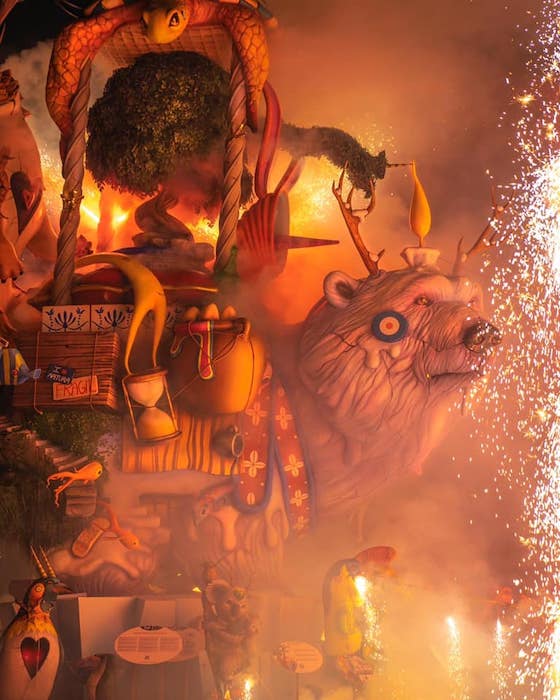
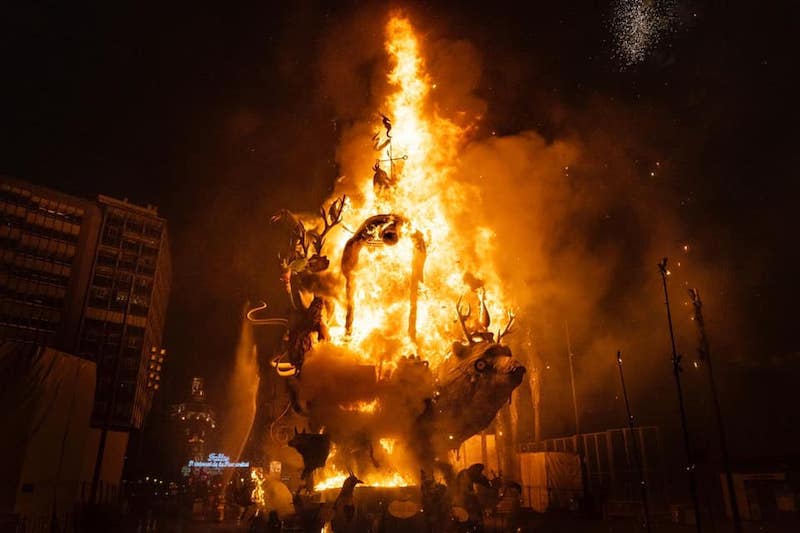
This connection between DULK’s imaginary creatures and the ecosystems they inhabit also appears in The Giant Change, the 6.5-metre flamingo sculpture he created at STRAAT in 2023. Inspired by the Albufera, the wetland near Valencia, the work grew out of DULK’s concern for its flamingos and the fragile ecosystem they inhabit.
At STRAAT, scale changes the encounter without changing the logic behind the work, as the meticulous animal that might occupy the centre of one of DULK’s paintings becomes physically enormous while still asking us to look beyond the immediate spectacle of the creature itself, towards the landscape it comes from and what is happening there.
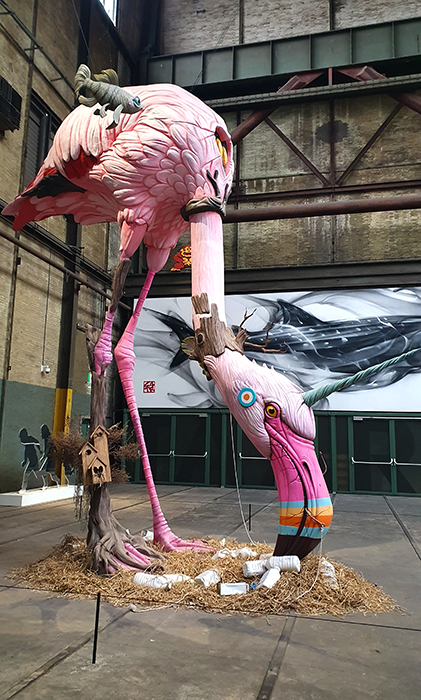
That enormous bird at STRAAT belongs to the same fantastical universe that runs throughout DULK’s work, yet once again there is a very real landscape underneath it, just as there is behind the stork in Fuenlabrada and, much more literally, behind the coastal wolf he photographed in British Columbia.
Reality is dismantled and reconstructed until it becomes one of those impossible worlds that are unmistakably his, without ever completely losing its connection to the encounter or landscape where the story began. The more time you spend with DULK’s work, the more those connections begin to surface among the smallest details, turning creatures that might initially seem to belong entirely to fantasy back towards the landscapes they came from and the stories unfolding within them.
Seen in this context, the photographs included in Silent Encounters become particularly interesting because, for once, we can see both ends of that process: the animal encountered in the wild and the imaginary world it eventually enters.