Giulia Blocal
This editorial on the playful side of street art and its political potential was originally published in my street art newsletter, Beyond the Walls, which lands in inboxes on the 1st of every month with reflections and unexpected finds. This excerpt is from the December 1st, 2026, edition. Subscribe here to receive future issues.
One of the things that first drew me to street art was its ability to cause glitches in the daily routine: small interruptions that make you look twice at something you were about to walk past and that, more often than not, leave you smiling.
Cities are full of visual instructions that we read so automatically the process barely registers anymore, and French artist Clet Abraham has built a whole practice around that blind spot. His stickers turn up on traffic signs, where a tiny figure might be leaning against an arrow as if trying to shove it somewhere else, or hauling the white bar of a no-entry sign on its back. The sign still gives the instruction it was designed to give, which is what makes the joke work: you recognise the familiar symbol immediately, then discover someone has found another way to interpret it. Something you’ve passed hundreds of times without a glance suddenly holds your attention.

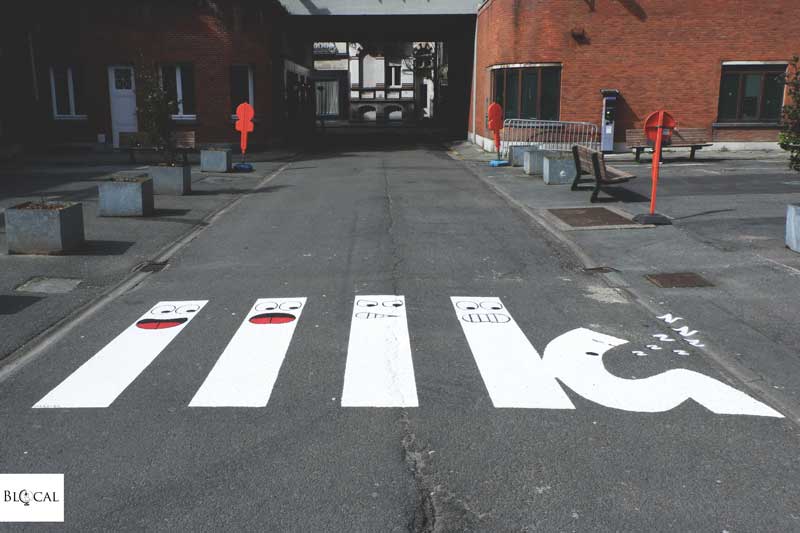
OAKOAK, another French artist, takes the existing features of the city as his raw material, incorporating everything from cracks in walls to pedestrian crossings into his playful compositions. I once photographed him at work in Belgium, where the white stripes of a crossing became part of an entirely different scene. What I find particularly interesting about these interventions is how much they depend on the circumstances in which we encounter them.

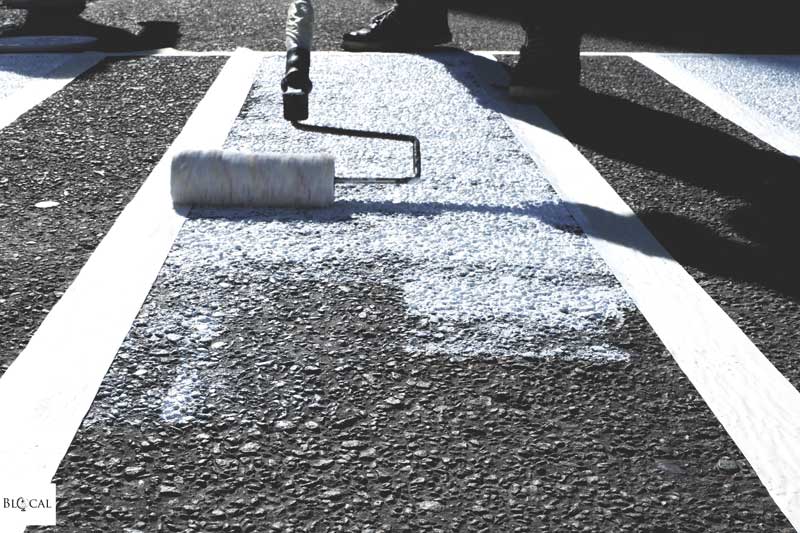
When we enter a museum, we deliberately set aside time to look at art, whereas OAKOAK’s little surprises catch us in the middle of our usual routines, when we’re simply trying to get somewhere. The pavement beneath our feet suddenly becomes something worth looking at, and for a moment, the practical purpose of that space gives way to a different way of experiencing it.
The idea of interfering with our habitual experience of the city has an important precedent in the Situationist movement, which challenged the predictable ways people experienced modern urban life. One of their strategies was détournement, the appropriation of familiar images and messages to redirect their meaning, often using the language of the dominant culture against itself.
We can recognise this same principle in Subvertising, a form of culture jamming that appropriates the visual identity of commercial advertising to undermine its original message. Its effectiveness relies on our familiarity with advertisements, whose images and slogans have become such a constant presence in urban life that we often recognise them without paying much attention to what they communicate.
In 2019, Italian artist Hogre used this approach for Ruinair, a series of interventions dressed in Ryanair’s familiar branding and advertising flights to the Great Pacific Garbage Patch, the vast accumulation of plastic waste in the Pacific Ocean. Anyone who has walked past enough airline advertisements knows the promise of a bargain getaway so well that another poster might barely register, until an absurd destination offered with the same cheerful confidence makes you look again. By exploiting a visual identity we recognise almost instantly, Hogre turns the advertisement’s own language into a criticism of the environmental impact of air travel, with humour providing the opening for a more uncomfortable reflection.

What’s interesting, though, is that play doesn’t need an explicit political message to challenge the way we experience urban space. Cities are largely organised around efficiency, with infrastructure designed for specific purposes and public spaces accommodating particular patterns of behaviour. Urban theorist Quentin Stevens describes play as a lived critique of this rational organisation, because engaging with an environment in ways that serve no predetermined practical purpose allows us to discover possibilities that its intended functions tend to conceal.
There’s something quietly subversive about using an ordinary element of the city simply to amuse ourselves, especially when so much of our relationship with urban space is shaped by instructions about what we should be doing there.
This brings to mind Henri Lefebvre’s concept of the right to the city, which understands urban inhabitants as active participants in shaping urban life. A playful intervention cannot, by itself, change who controls public space or determines how it should be used, but it can make those established conventions momentarily visible and open to question. When artists invite us to see an unexpected possibility in something we’ve always approached according to its prescribed function, they also encourage us to imagine a more active relationship with the city, one in which our experience of public space isn’t entirely defined in advance.
This is one of the reasons street art has kept me interested for so many years: the more you learn to read it as part of the everyday fabric of a city, the more you begin to question what you’ve grown accustomed to seeing. Once you’ve spotted one sign that someone has tampered with, you start to realise how many others you’ve stopped reading.