Giulia Blocal
As part of the program for the 10th edition of Glasgow’s very own Yardworks Festival, I moderated a panel on legal and illegal graffiti and street art featuring KMG (Street Artist), Tim Marschang (Street Art Cities), Izzie Hoskins (Bring the Paint Festival), Lars Pedersen (Institute of Urban Art), Daniel Claessens (All Caps Festival), and RASK (Graffiti Writer).
Together, we explored artistic freedom, institutionalization, legality, and the compromises that often shape graffiti and street art today. The conversation raised too many urgent and thought-provoking questions to remain confined to the festival stage, so I wanted to share it with you here.
I had also prepared many more questions and provocations that we simply did not have time to unpack during the panel, so I will continue expanding on those themes in this month’s editorial for my street art and graffiti newsletter, Beyond the Walls.
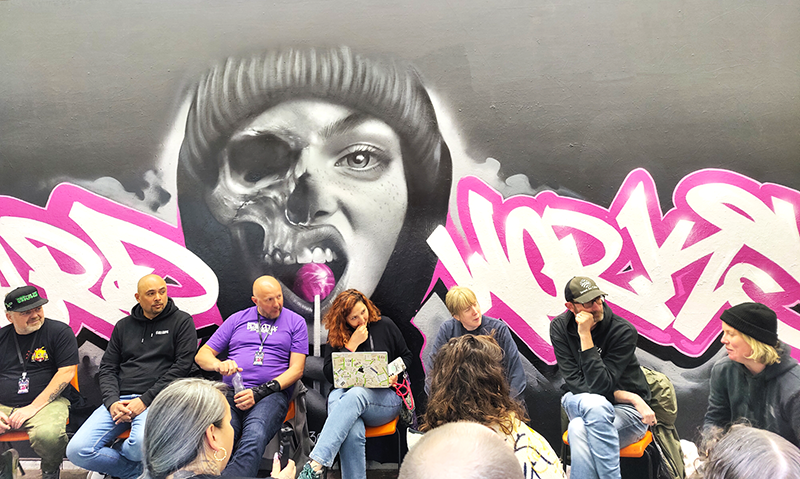
Giulia Blocal: Welcome to today’s panel, “Legal, Walls?” I think the question mark matters, here. 😄 Because when we talk about legal walls, we are not just talking about permission. We are also talking about who gets access, who gets to decide, and what kind of work becomes visible.
Joining me on stage today are artists, curators, and festival organizers, all working within this ecosystem but from very different positions and across different countries. The idea is to look at legal walls from multiple perspectives and perhaps also question some of the assumptions behind them. Since each of you comes from a different background, I have prepared a few specific questions, but please feel free to jump in, respond to one another, or disagree.
The first question is for Tim Marschang, one of the founders of Street Art Cities.
Tim, neither of us is directly involved in producing walls, and we often document work created outside official frameworks, pieces made without permission. On the Street Art Cities app, users can find both legal and illegal works, without any real distinction between them. From your perspective, what role does unsanctioned work still play today? Is it still central to the culture, or is it becoming more marginal?
Tim Marschang: Yes, we are a community-driven project where hunters upload photos of festival murals and commissioned works, but many of our hunters are also deeply interested in the illegal side of street art and graffiti, so they document graffiti pieces as well.
You asked whether it is still relevant, and yes, it absolutely is. I was just speaking with an artist over there, and he said, “I love painting large murals at festivals, but for me it is also exciting to paint in illegal places. Finding the right spot is a huge part of it. You search for a location, think about a concept, and then leave your work out in the open.” That grassroots side of graffiti is still very much alive. I think it remains extremely important, and necessary too.
[Editor’s note: festival walls are usually assigned to artists, while many legal walls and halls of fame are already predetermined by the municipality. As a result, the process often lacks the “location hunting” aspect and the spontaneous relationship with urban space that are central to both graffiti and street art.]
Giulia Blocal: Does anyone want to jump in?
Daniel Claessens: Yes, I will. My name is Daniel, from All Caps Festival. We produce independent public art through a year-round program, and we also organize the festival itself.
The way we work requires permissions for most of what we do. Things have changed a lot over the years. We have been producing murals for 15 or maybe 16 years now, and when we first started, the reaction was basically: “Great, now you don’t have to run from the police anymore, and you get free paint and free beer.” That was enough.
Today, people understand that these artists are professionals. This is not just a hobby, it is their job and their income. There needs to be a fair structure where artists create a strong mural and are paid properly for their work. It is no longer about “here’s 50 quid, a few beers, and some extra cans of paint.” The scene has evolved into a system where we secure permissions, fees, and budgets that allow us to produce high-quality murals.
At the same time, that does not mean the illegal side has become obsolete or unimportant. When I curate, I care about the final result. I do not care whether someone graduated from an art academy and started painting outside because their studio was too small, or whether they are self-taught and came from painting subways, trains, and rooftops before making a living through murals. I work with both backgrounds equally.
And honestly, I also do not mind when someone comes to me after the festival and says, “Can you open the paint container? I found a beautiful wall.”
Giulia Blocal: I am sure you do not mind 😄 because I know you come from a graffiti background. But you also come from a culture rooted in illegality and autonomy, and now you operate within a highly structured festival system based on sponsors, institutional partnerships, and public funding.
So my question, which I would also like to extend to the other festival organizers here, is this: where do you feel the biggest compromises happen, and how do you deal with them?
Actually, let’s start with Izzie Hoskins, so she also has the chance to introduce her festival.
Izzie Hoskins: Hi, my name is Izzie, and I am the artistic director of Bring the Paint Festival.
When you ask about compromises, I think there are really three different elements within what we are discussing and what we do. First, there is illegal graffiti, which, as Daniel mentioned, includes trains, tracksides, rooftops, city walls, basically anything unsanctioned.
Then there is the legal wall. For me, a legal wall is a space where it is possible to create a mural or a piece legally, without instructions or creative restrictions.
Beyond that, there is the festival context.
What matters to us, at our festival, is that artists are able to create what they genuinely want. Even though street artists are paid a fee, the work is not commissioned in the traditional sense. Nobody tells them, “Can you include our logo?” or “Can you make this about King Richard III because we are in Leicester?” Instead, the idea is: paint what you want.
At the same time, compromises do exist. Even when organizing a festival that aims to avoid creative restrictions, we still cannot present artworks that will seriously upset the public. Leicester is a very multicultural city, and political statements are something we generally cannot accommodate within the festival.
For example, at one edition of the festival, an artist painted a humanized pig. That became a major issue because Leicester has a large Muslim community, and the piece was eventually vandalized. It was not something I had anticipated, because it was outside my own cultural background and experience.
So there are compromises, whether we openly acknowledge them or not. Authenticity is extremely important to me, and I want artists to paint freely, but there are still limits. We cannot include overt political statements, extreme sexual imagery, or nudity.
And then there is the question of representation and authenticity within the culture itself. Like Daniel said, it is important to include artists from different backgrounds, whether they come from universities and formal art education, or from illegal graffiti culture. Both perspectives are part of the scene and should be represented.
Giulia Blocal: Do you require sketches? And do those sketches need to be approved by the municipality or by the building owners?
Izzie Hoskins: At our festival, I secure the walls myself by approaching the landlords. Some properties belong to the council, while others are owned by private landlords.
As a general rule, I do not provide sketches. Instead, I present the artist’s portfolio and ask whether they are comfortable with that artist creating a work on their wall, probably within that kind of style or visual language.
Because once a sketch is required, it starts moving into commissioned territory. If you send a sketch, the response quickly becomes: “I like it, but can you move this over here?” And then the whole point is lost.
Giulia Blocal [to the other festival organizers]: What about your festivals? Do you require sketches?
Lars Pedersen: Hi, I’m Lars, and I lead the Institute of Urban Art in Copenhagen. I curate two festivals in Denmark: Roskilde Festival and Slagelse Street Art Festival.
I can maybe build on what was just discussed. Personally, I do not think we really have many festivals dedicated purely to graffiti. Most festivals are more focused on street art or muralism. To me, graffiti is fundamentally letter-based painting. It can exist in legal spaces or illegal ones, but obviously illegality adds excitement and power to graffiti.
If you took the exact same piece and painted it legally in one place and illegally in another, the illegal version would probably carry more energy and meaning. At the same time, legal graffiti can still be excellent, and we have a lot of that here at Yardworks Festival. I have been painting a piece here myself.
What you touched on is the reality that festivals involve working with authorities, sponsors, municipalities, and partners. If you want your festival to continue, you have to keep everyone happy. But I completely agree that this work should be approached as an art form, not simply as commissioned decoration.
Of course, if someone wants a commission, then they should pay properly for it. If you want sketches, pay artists for the sketch process. If you want complete control, then put more money on the table.
Most festivals are actually giving cities an enormous amount of art either for free or at a very low production cost. When I work with municipalities, landlords, or sponsors, I always make sure they understand this. A mural produced through a festival might cost £1,500 within the festival structure, but the actual commercial value of that artwork could easily be £50,000.
People need to understand what they are receiving. Festival-based mural production is, in many ways, a gift to public space. If somebody called me a month later asking for the exact same artwork outside the festival context, the price would probably be ten times higher or more. And then, of course, there would also be questions of control and approval processes.
I genuinely think these festivals are a gift to cities and public spaces. Municipalities, politicians, sponsors, and property owners should be happy that we are out there doing this work.
RASK: Hi everyone, I’m RASK. I have been a graffiti artist for many years, and I also organize the Bridge Jam graffiti festival in Ireland.
What I want to add is that there is still this widespread perception that we do this purely for fun, and therefore that we should do it for free. Because of that, the idea of monetizing graffiti or mural work can be difficult for a lot of people and institutions to understand.
I often compare it to a friend of mine from school who became a professional football player and played in the Japanese league. During the off-season, when he comes home in the summer, he still goes out to kick a ball around with local kids because he genuinely loves football. But when he puts on the jersey professionally, he is earning a huge salary every week.
That is the balance.
He is still playing football because he loves it, just as we still paint because we love it. But as Lars said, festivals involve fees, production costs, logistics, and a huge amount of labor. All of that has value and needs to be recognized.
Giulia Blocal: Daniel, do you want to add something? Do you compromise?
Daniel Claessens: We try not to. Sometimes we have to, but we try to keep compromise to an absolute minimum. Artistic freedom, like Izzie said, is the number one rule.
I do ask artists for sketches, but I never show them to the wall owners. The reason I ask for them is practical rather than creative control. If you send me a sketch, it means you have already thought about the wall and the color palette, so by June I can already order all the paint we need for the festival.
Lars Pedersen: Of course, it also makes production much easier, which is an important aspect.
Daniel Claessens: Exactly. Then the artist arrives and say, “Wow, the 283 colors I ordered are already here.”
Because if you do not organize things in advance, problems start immediately. We learned that the hard way. Artists arrive, and for those who are not certified to use the lifts, we first have to arrange training for them.
Then, the following day, we do something we call “Meet the City.” Coming from an artist background myself, I know what this lifestyle actually looks like. People imagine artists are traveling the world and constantly enjoying these amazing experiences. But in reality, an artist flies to Japan, goes from the airport to the hotel, from the hotel to the paint supplier, and from the paint supplier straight to the wall.
Ideally, they would need fifteen days to complete the mural, but instead they get seven. So they work from morning until it becomes too dark to see. Sometimes they even bring in lights to continue painting. They finish the wall, often without ever properly seeing it in daylight, and then they are already back on a plane home or heading to another city.
What we try to do is create a different rhythm. Artists arrive, complete the skylift training, and then we dedicate one day to experiencing the city itself. I genuinely want artists to discover Rotterdam. We take them on a boat, we bring them to great restaurants, we show them the city.
And we can do that because the artists already submitted their paint orders in advance, the materials are prepared, and the entire schedule becomes more relaxed and human.
Giulia Blocal: Yes, the “Meet the City” day is extremely important. For me, it is actually crucial, because it allows artists to create something that is connected to the place they are working in.
The problem with the process you described, where artists go directly from the airport to the paint shop and then to the wall, is that they can end up painting essentially the same mural in Japan, Rotterdam, or New York. The work becomes disconnected from the location, the context, and the neighborhood surrounding it.
Whereas I believe the whole point of mural art, or street art more broadly, is that it should be contextual. Unlike a canvas that can simply move from one museum to another, a mural is born in a specific place and often in direct relationship with the people and environment around it.
I have worked with festivals where this kind of introduction to the city is considered part of the production process itself, and very often ideas emerge precisely because of that experience. Of course, every artist already has their own visual language and style, and ideally they should also have researched the city and the neighborhood beforehand. But spending time in a place in real life, rather than just seeing it through a PowerPoint presentation sent by the festival, changes your perception completely. Artists may notice something specific, a person, a local story, a building, or simply an atmosphere, and then incorporate those details into the work.
And yes, from a festival perspective, that extra day represents an additional cost, because it means one more production day multiplied across many artists, but I think it gives back a huge amount. Even if only three out of ten artists absorb something meaningful during that day and bring it into the mural, the final works become much more powerful for the community.
I have a question for KMG, but I can see someone in the audience would like to jump in first.
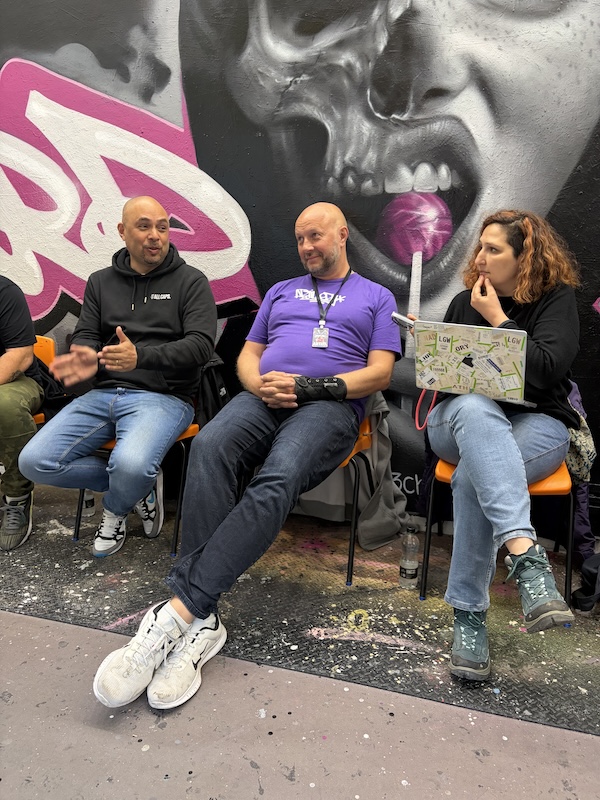
Katherina Doxiadis: Hi, I’m Katie, and I’m the managing director of the All Caps Festival.
I want to add that, in addition to the “Meet the City” day, where we actually explore Rotterdam together, we also organize family-style dinners every evening. We ask artists to stop painting around 6 or 6:30 p.m., partly because many of the murals are produced in residential neighborhoods and we do not want to disturb the people living there late into the evening.
We also send every artist a detailed file about the city and, more specifically, about the neighborhood where they will be painting. It includes information about the local community, the history of the area, and how the neighborhood developed over time.
The artists still have complete artistic freedom, but if they want to, they can incorporate elements of that context into the mural and start thinking about it in advance. We send that material together with the invitation to participate in the festival.
Izzie Hoskins: Yes, we also provide artists with contextual information. For example, we might explain that the building they are painting used to be a theater that recently closed down, or tell them something about the history of the area, so they already have a sense of the place they are working in.
But I also think it is a bit naive to imagine that, within a festival context, an artist can simply arrive and spontaneously respond to the city without any prior planning. [Editor’s note: I do not think this is naive at all. I have seen artists respond to a city spontaneously and successfully on several occasions. It depends entirely on how well organized, yet flexible, a festival is.] Festivals require a huge amount of infrastructure and organization. We ordered 12,000 cans of paint for the festival, and even then we still ended up saying, “We do not have enough light blue for this artist.” So there has to be a certain level of preparation.
That is also one of the differences between festival murals and more independent legal painting. As an artist myself, when I go out painting on my own, I usually do not have fifty cameras pointed at my face. Even within legal contexts, painting can still feel like a private experience shared with peers.
At a festival, the city itself becomes the audience. Painting turns into a performance.
So I think it is important to distinguish between mural art within a festival framework, experimenting independently on your own terms, or climbing a building to paint a rooftop. These are all different aspects of spray paint culture.
And yes, responding meaningfully to a city is important, but that kind of response also depends on preparation and organization, which is why the work we do behind the scenes is so essential.
Giulia Blocal: My next question is for KMG. Katie, you move between sanctioned and unsanctioned contexts as an artist. How do you navigate the space between commissioned work and illegal or unsanctioned work? Do you approach them differently, and what actually changes for you in the process?
And most importantly, what do you allow yourself to do in unsanctioned work that would not be possible otherwise?
KMG: Yeah, I mean, a lot of this connects to what we have already been discussing. When you are creating murals or commissioned pieces, it is your job, so there is a responsibility that comes with it. I feel responsible for responding as thoughtfully as possible to whatever brief exists, and for putting real effort into research and development.
For me personally, it is important that the artwork connects to the landscape it exists within. I think you have to consider the space and the people who are going to live with the work you create. So I approach that side of my practice through quite a professional lens.
The unsanctioned side is different. That is where I have complete creative autonomy and the freedom to create whatever I want.
I also think it is interesting to consider how much social media has changed things. Today, as artists, it is incredibly important to share and promote our work because that is how we get more jobs. But when I started painting, social media did not exist. There was a freedom in creating without worrying about cameras, lenses, people filming you, or taking photographs.
I still really value that freedom. Going out painting illegally, for me, is something I do for myself. You can be as expressive and experimental as you want. You can look for strange spots. Legal walls absolutely have their place, but honestly, I often find them quite boring. I am not talking about festivals specifically, but legal walls in general. They are useful for practicing ideas, but they are usually the same dimensions over and over again. You paint, buff it, and then paint again.
What I love is the freedom of finding unusual locations, whether in the city or in rural landscapes. And I think reaction is a huge part of it too, being able to go out with a bag of cans and no fixed plan, simply responding to your surroundings in the moment. There is something really special about that spontaneity, and I would hate to lose it.
The mural industry is very different from legal walls, which are very different from graffiti, which are again different from vandalism. There are so many layers and facets within spray paint culture.
And you meet people who only paint murals and never paint outside of that context. I actually find that fascinating, because personally I would find it stressful to work only on commissioned projects. Even when festivals give you freedom and tell you to paint whatever you want, it is still a job. There is still pressure involved. You still have to switch into a professional mindset.
So I always find myself wondering: if you never paint just for fun, then why are you doing this?
I think it is really important to hold onto that side of it. My son is eleven and he is starting to paint now, and he already hates legal walls. He says, “This isn’t fun.”
Izzie Hoskins: Yeah, how much fun is exploring.
KMG: Exactly!
Lars Pedersen: I believe graffiti, at its core, is always an act of rebellion. There is something amazing about finding an abandoned building or discovering a place that almost seems to invite you to paint it, purely for the sense of freedom and enjoyment.
I still paint for fun because I need to. Sometimes I literally take a day off from painting just to go out painting. 😄
Giulia Blocal: Your curatorial work is also part of a much larger music festival structure, so I imagine your role is less about controlling or directing each individual artwork and more about building the right infrastructure around the artists, making sure everything is in place for them to create freely while still functioning within the broader framework of the Roskilde Festival.
Lars Pedersen: Yeah, and I think a big part of that also comes from the fact that it is temporary. At Roskilde Festival, we are essentially building a temporary city, painting that city, and then watching it disappear again. It only exists for one week each year.
That temporary nature makes things much more forgiving. You can get away with a lot more because the work is only going to exist for a short time. Urban festivals are different because you are intervening in an actual city landscape and leaving the artwork behind. Some murals might remain until the next festival, while others can become part of the urban environment for years. It creates a completely different dynamic.
For me, the power of graffiti and street art comes from taking something from the city and transforming it. That is where freedom exists. That is where we push against the structures and dynamics of society. Instead of asking permission or simply following the rules, we take a space, paint it, and turn it into something meaningful to us.
People can respond however they want. They can join us and appreciate it, ignore it completely, or actively fight against it by buffing it, painting over it, or writing angry letters to the council.
But I think the reason graffiti and street art still matter today, and the reason they continue to exist after more than fifty years, is because once people catch the graffiti bug, they stop accepting cities without human expression.
At the end of the day, all the paint we put onto walls comes from this urge to express ourselves and leave a mark. For some people, that becomes a lifelong mission. And that is also why this culture has evolved into an industry. Now it is a profession. Now we have festivals and institutions built around it. You cannot stop it. It just keeps growing, and more people keep getting involved.
What amazes me about Yardworks Festival, and what makes it unique compared to anything else I have experienced, is that thousands of people in Glasgow buy tickets just to come inside and watch us paint.
Because here, painting becomes a performance.
At this festival, I do not really feel like I am making rebellious work or taking over space. It feels more like we are presenting to the public what we normally do out in the wild, almost like a zoo.
And I think the audience becomes part of it too. People connect with the artists, with the process, with the culture itself. Most visitors leave genuinely enjoying the experience, and later, when they encounter graffiti somewhere else in the city or in another country, maybe they react differently. Maybe they think: “Okay, perhaps painting that old lady’s house was not ideal, but the bird they painted is actually beautiful.”
I really think public opinion has shifted enormously over the last two decades. That is why events like this can exist. That is why people are willing to pay to attend them. Painting has become far more socially accepted, and more people are willing to stand on the side of the artists.
Honestly, I do not think most people want to live in completely clean cities. I think most people would rather live in painted cities, or at least I hope so.
RASK: Yes, people genuinely like colors. It breaks up the grey surroundings of everyday urban life. Bright colors affect people’s moods, and in many ways what we do interrupts that monotony.
Cities are already filled with visual interruptions through advertising everywhere you look. In a sense, we are also advertising ourselves.
KMG: That is a really important point. There is a guy where I live who goes around buffing graffiti, and I always found it fascinating because he genuinely hates it. And I remember arguing with him once about the fact that advertising is everywhere around us.
We have been conditioned by society to accept the monetization of public space. Advertisements cover buses, walls, buildings, entire city landscapes. They are everywhere. But somehow, if something generates profit, it is automatically considered legitimate.
For me, what matters about graffiti and street art is that they introduce a form of democracy into public space. If you do not like a piece, you can paint over it. It becomes a conversation about taking ownership of the urban landscape rather than simply accepting whatever commercial imagery is imposed onto it.
Izzie Hoskins: My favorite mural from our last festival was actually the one that caused the most conflict and generated the most complaint emails.
At each edition of the festival we try to paint new locations, but there is one site we regularly repaint because it is made of wooden cladding and starts looking worn after a couple of years. Previously, there had been a beautiful portrait of Jimi Hendrix by WonABC there. Then Taps and Moses came in and created a very abstract mural made up of their throw-ups.
As a graffiti writer, and as someone who understands the work of Taps and Moses, I loved it because you could see how the whole composition functioned almost like a jigsaw puzzle of letters.
But the amount of angry emails I received from members of the public was incredible. None of those people had ever emailed to say how brilliant the Jimi Hendrix mural was or how grateful they were that the festival had brought it to the city. But suddenly they were furious that we had painted over it with what they described as an absolute monstrosity.
Honestly, I loved that reaction too. And I just wanted to reply: “Haha, you’re an idiot.”
Giulia Blocal: We have a question from the audience. Please go ahead.
[Editor’s note: Unfortunately, my phone could not properly capture all the audience questions, as we did not have a microphone and the panel took place in a very loud room directly beneath the DJ booth.]
Audience Question 1: Listening to all of you, I can hear that there is still a real excitement around painting illegally. I work as a designer, and I am paid by city authorities to create work for them, so I have never really taken that risk because I worry about losing my job.
For me, legal walls are the only realistic option, although part of me still feels that this kind of work is somehow meant to exist illegally.
KMG: I do think legal walls have an important place. As a woman, I have noticed that as legal walls have become more common in cities, more women have entered the scene as well. Before that, many women simply did not feel safe painting outside at night.
A lot of women entered through legal walls, especially within the mural scene, but still, that is where they began. Legal walls gave them a place to build confidence and paint without having to be alone in the street at night.
So I absolutely think legal walls are valid, and I also think what you are saying is completely valid too. Not everybody wants to paint illegally, and that is okay. Painting illegally comes with risks, and the older you get, the more calculated you become about which risks you are willing to take.
I know that is true for me personally. I am a single mother, and I definitely do not take the same risks now that I took when I was sixteen or seventeen years old, because there is simply more at stake.
Legal walls can offer a sense of safety. They allow people to paint without constantly looking over their shoulder or worrying about getting caught. But they also create spaces where people can learn, grow, and build confidence within the culture.
Unfortunately, at this point we had to wrap up the discussion and leave the room for the next event in the festival program. Yet I felt the conversation was only beginning.
I had prepared many more questions, reflections, and provocative thoughts around legality, artistic freedom, public space, institutionalization, and the contradictions within graffiti and street art culture, but there simply was not enough time to explore them all during the panel.
So I decided to continue this discussion in this month’s editorial for my street art newsletter, Beyond the Walls.
Subscribe below and let’s keep the conversation going!