Giulia Blocal
Summer is around the corner, and whether you’ve already booked your trip or are still wondering where to go next, let me ask you something: what if you planned it with a book instead of an algorithm?
At a time when TikTok and Instagram keep sending us to the same cafés, viewpoints, and “must-see” spots, I still believe in the power of a good book. Especially a book that has been walked, researched, photographed, written, and carefully put together by someone who knows how to read a city through the signs left on its walls, and invites you to do the same.
Every city has a version designed for visitors, and another shaped by the people who actually live there. That second one is usually more fragmented, contradictory, and emotionally richer.
Street art and graffiti often pull you away from the staged version of a city and closer to that deeper layer. They interrupt polished narratives, break the illusion of the perfect postcard, and remind you that a city is first of all a place where people live, argue, protest, leave traces, and make space for themselves.
This is why looking for walls when you travel can lead you to some of the most interesting urban spaces, including places that were never designed to be interesting in the first place: vacant lots, railway underpasses, abandoned buildings, neglected parks, neighbourhoods in transition, and contested corners where different visions of the city collide.
These places became meaningful because people found ways to use them long before anyone thought of preserving, promoting, or branding them.
And this is why, when graffiti and street art books focus on a specific city, they become an alternative kind of guidebook. They lead you away from the usual landmarks and into neighbourhoods where the city feels more layered, more local, and often more honest. They help you notice walls, side streets, shutters, old signs, temporary marks, and stories that rarely make it into conventional travel guides. Most importantly, they give you a reason to walk differently.
This is also the kind of travel I explore every month in Beyond the Postcards, the travel side of Beyond the Walls, my long-running newsletter on street art, graffiti, off-the-beaten-path travel, and a bit of my life in between.
In these alternative travel guides, I share personal routes, local tips, cultural context, and unexpected ways to explore a city through its walls. Recommending street art books dedicated to that city is one of the many ways I suggest new paths and more original explorations.
Those guides are entirely supported by readers (thank you!), and reserved for paid subscribers. For this post, freely available to everyone, I decided to gather some of those reading recommendations in one place -partly because summer is coming, and I want to help you prepare for your travels with books that can genuinely change the way you move through a city, partly because I want to support fellow street art book writers, independent publishers, and the people who keep this culture alive on paper. 🫶 ( It’s a matter of karma, after all!)
So here they are: my street art book recommendations for your summer travels, divided by city.
📢 Full disclosure: the links below are affiliate links with Le Grand Jeu an independent bookshop specialising in street culture, graffiti, street art, and DIY aesthetics. If you buy through these links, I’ll receive a small commission at no extra cost to you. It helps me keep creating independent content, while supporting a real bookshop rooted in the culture, one that cares about the books, the authors, and the communities behind them.
Street Art Books to Inspire Your Next City Trip
Graffiti and Street Art Books about Amsterdam:
- When Keith Haring came to Amsterdam in spring 1986 for his first solo show at the Stedelijk Museum Amsterdam, he did more than exhibit his work. He moved through the city, met teenage graffiti writers and connected easily with the local scene. The book “The Dutch Adventures of Keith Haring. Amsterdam Notes” revisits that moment, including the backlash from critics and squatters who dismissed his work as opportunistic, often ignoring his engagement with gay culture, AIDS, Apartheid and environmental issues.
- Yaki’s Scrapbook is a time capsule of early graffiti history, reproducing a 1983 scrapbook compiled by Tanya Trijbels, then wife of Amsterdam gallerist Yaki Kornblit. She preserved press articles, photographs and materials from the exhibitions he organized with artists such as Futura 2000, Blade and Dondi.In the early 1980s, Kornblit was the first art dealer to give New York graffiti writers solo shows in a formal gallery setting, at a time when graffiti, created largely by teenagers of color from marginalized neighborhoods, was dismissed as vandalism.
- Tunnel Vision offers a meticulous, full-scale photographic reproduction of Amsterdam’s Oostlijn metro tunnel, transforming a four-kilometer underground stretch into a 12.5-meter-long visual archive on paper. Beyond documenting four decades of graffiti, the book traces the intertwined history of Amsterdam’s urban development and its subcultural expressions, revealing how infrastructure and illicit art evolved side by side.
- White Phosphorus is a collection of poems by Amsterdam’s street poet Laser 3.14.
- Shoe’s Black Book: Graffiti in the 1980s offers a window into an artist’s formative years. Before the galleries, the recognition, his development as a typographer and founding the Calligraffiti art movement, there was this: a worn and relentless black book filled with tags, pieces and outlines.
- Memorabilia: A Scan Through Dutch Rave Culture assembles 432 original flyers into a dense visual archive of Dutch rave culture, bridging private collections and institutions such as Paradiso and RoXY. The book functions as a collective time capsule, tracing two decades of nightlife history from the rise of gabber to the consolidation of labels like Rush Hour and Clone Records.
- Amsterdam Bike Crates is a photobook documenting a frequent target for writers (and my personal obsession).
Graffiti and Street Art Books about Athens:
- “The history of graffiti in Greece 1984 – 1994” by Charitonas Tsamantakis (research), edited by Orestis Pangalos, Futura Publications (Athens, 2016). A remarkable bilingual (Greek and English) volume that offers a unique window into the origins and early development of Greek graffiti culture. It’s packed with rare photos (many from the 1980s) featuring breakdance crews, NYC-inspired sketches, backpieces, and early graffiti pieces by Greek writers, in Athens and beyond.
Graffiti and Street Art Books about Barcelona:
- Polyrhythmic Beats, the monograph of local street art legend Kenor, written by Rafael Schacter.
- Besi, Tres Xemeneies, Barcelona explores Barcelona’s hidden and abandoned spaces through the lens of urban explorer Bennett Encke. Structured in four chapters, the book documents underground infrastructures and overlooked sites tied to the city’s modern urban planning.
- This photobook by BCN KILLS showing spontaneous street moments in Barcelona.
- Ara Comença l’Scooter Run. Scooterisme a Catalunya 2009-2019 by Hector Vilar is the first book documenting the scooterist/skin/rudeboy scene in Barcelona and Catalonia.
- This collection of flyers and posters of hip hop jams in Barcelona from 1990 to 2000.
Graffiti and Street Art Books about Berlin:
- One Week with 1UP, by Martha Cooper, Ninja K and 1UP, for an adrenaline-heavy look at one of Berlin’s most notorious graffiti crews through tunnels, rooftops and train actions.
- Power of Style: Berlin Stylewriting, for a scene-built book focused on letterforms, construction, bombing, concept walls and train pieces from early-2000s Berlin.
- DECADES Vol. 1: 1990–2000 Graffiti Writing in Berlin, for a deep dive into the decade when Berlin graffiti was taking shape after reunification, told through images and personal accounts from inside the scene.
- Art or Chaos? Graffiti on the Berlin Wall, for a historical look at the Wall as a surface of subculture, emotion and politics before it became a global tourist image.
- Paradox.Paradise, by Lukas K. Stiller, for a nocturnal, almost cinematic journey through Berlin with Mr. Paradox.Paradise, somewhere between graffiti documentation and urban photography.
- Backjumps Live Issue 2, by Stephen K. Schuster, for Polaroids from Berlin in 2005, with names such as Akim, Brad Downey, Futura, Os Gemeos and Poet appearing like fragments from a crucial moment in the city’s urban art history.
- Berghain: Berlin Bacchanales, by Guillaume Robin, is not strictly a graffiti book, but belongs on the same Berlin shelf for anyone interested in club culture, bodies, ritual and the city’s mythology of the night.
Graffiti and Street Art Books about Bristol:
- If you’d like to dive deeper into Bristol’s street art history, my first recommendation is Vanguard: Bristol Street Art: The Evolution of a Global Movement, the catalogue of the award-winning exhibition held at M-Shed in 2021. Presented as a collection of essays, it offers the first major overview of Bristol street art, tracing its evolution from the early 1980s to the present day.
- If you read Italian, my friend Andrea Lucarini has recently published A Bristol con Banksy, a compact introduction to the city. Street art, trip hop, activism, independent culture: all the elements that make Bristol such a unique place come together in its pages.
- Another excellent read is Massive Attack: Out of the Comfort Zone by Melissa Chemam. More than a biography of the band, the book explores the multicultural roots of Bristol through reggae, punk, sound system culture and activism, showing how the environment that shaped Massive Attack also helped shape one of the most influential underground scenes in Europe.
Here’s a short selection focusing on excellent books on Banksy:
- Banksy Captured Vol. 1 by Steve Lazarides (2019)
- Banksy Captured Vol 2 by Steve Lazarides (2020)
- Banksy by Andipa Gallery (2009)
- Banksy: Building Castles in the Sky by Stefano Antonelli (2021)
- You Are An Acceptable Level of Threat by Gary Shove (2019)
- Banksy: Completed by Carol Diehl (2021)
Graffiti and Street Art Books about London:
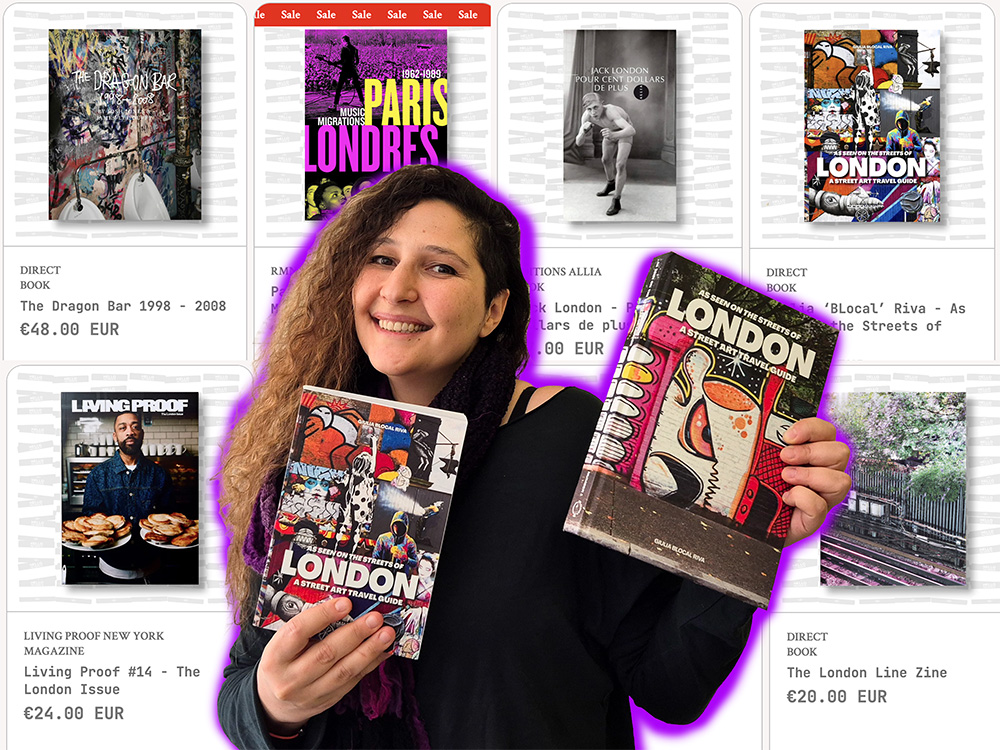
- The one, the only, the unapologetically brilliant, hopelessly over-researched, and slightly biased best book on London: As Seen on the Streets of London, by yours truly 🥰
- The Future Language of the Ikonoklast is not just about London, but a history of UK graffiti curated by one of its key figures, Remi Rough (also featured in our book).
- As Dotmaster also recalls in my book on London’s street art, The Dragon Bar was the place where all the street artists would gather, one of the defining underground hotspots of the scene. The book The Dragon Bar 1998–20081 pays tribute to this long-gone but not forgotten venue, featuring interviews with Banksy, Faile, INVADER, Mode 2, EINE, Sweet Toof, and many others.
- If you are fascinated by London Punks you should get the book Punk London 1977: the Roxy, the Vortex, Kings Road, and beyond by photographer Derek Ridgers.
Graffiti and Street Art Books about Madrid:
- Written by Madrid graffiti expert Javier Abarca, Guía del arte urbano de Madrid retraces the history of graffiti and street art in the city. (this book is only available in Spanish).
- The catalogue of MAST, the first graffiti exhibition in Spain, which took place in Madrid back in 1991;
- Rockocò, a legendary series of self-published fanzines from the 1980s (#8 features some of the earliest photos of graffiti in Madrid);
- Getting Up: Madrid Graffiti Autoctono traces the origins of Madrid’s native graffiti scene, from Muelle to later generations, through rare photos and drawings;
- Madrid Cierres is a comprehensive survey of Madrid’s shutter graffiti scene, combining visual documentation with firsthand voices of writers and artists united by a shared drive to occupy the city;
- Punk Graffiti Archive: Madrid documents the little-known “flechero” graffiti scene that spread across Madrid in the 1980s, before the influence of New York-style graffiti. Through unpublished images and archival material, it captures a local, punk-rooted form of tagging that developed independently, then disappeared as global graffiti culture took over.
Graffiti and Street Art Books about Naples:
- Napoli Punx – 1979 – 1983 documents Naples’ early hardcore punk scene through fanzines, photos, and the archive of Davide Morgera.It captures a generation driven by urgency, anger, and DIY culture, where music was less a form than a need to exist and resist.
- Dispacci #1: Malati is a photographic newspaper by Luca Santese and Marco P. Valli capturing Naples in the days leading to S.C.C. Napoli’s title win.Through fast, chaotic images, it portrays a city suspended in collective euphoria, where football, identity, and myth collapse into one shared, feverish moment.
Graffiti and Street Art Books about Paris:
- The one, the only, the unapologetically brilliant, hopelessly over-researched, and slightly biased best book on Paris: As Seen on the Streets of Paris, by yours truly 🥰
- Paris sous Paris: La Ville Interdite by Gilles Thomas & Gaspard Duval, a collection of photos and stories from the forbidden catacombs in Paris.
- Psyckoze – Intime Errance Cataphile collects a series of photos by graffiti writer and cataphile Psyckoze.
Here’s a short selection focusing on monographs of legendary street artists who have shaped the streets of Paris:
- Miss Tic – Flashback: 30 ans de création
- Jef Aérosol – Parcours fléché
- JR – 28 Millimeters
- Ernest Pignon Ernest by André Velter
- Invader – Part III
Graffiti and Street Art Books about Rome:
- Much of the golden era of Roman graffiti is captured in the book Rome Subway Art by Mathieu Romeo;
- while the early days of Rome’s street art scene are well represented in the book Roma Omnia Vincit by two old pioneers of the movement, Diamond and JB Rock.